
Affiliate disclosure: World Cup Tribune participates in the Amazon Associates Programme and other affiliate programmes. We may earn a commission on qualifying purchases at no extra cost to you.
Best World Cup Kits of All Time: Ranked & Where to Buy
Before the first whistle, before the anthems, before the tears — there is the shirt. The jersey a player pulls over their head on the day their country needs them most. Every four years, the World Cup gives football a new set of images that last a lifetime. Some of those images are defined entirely by what the players were wearing.
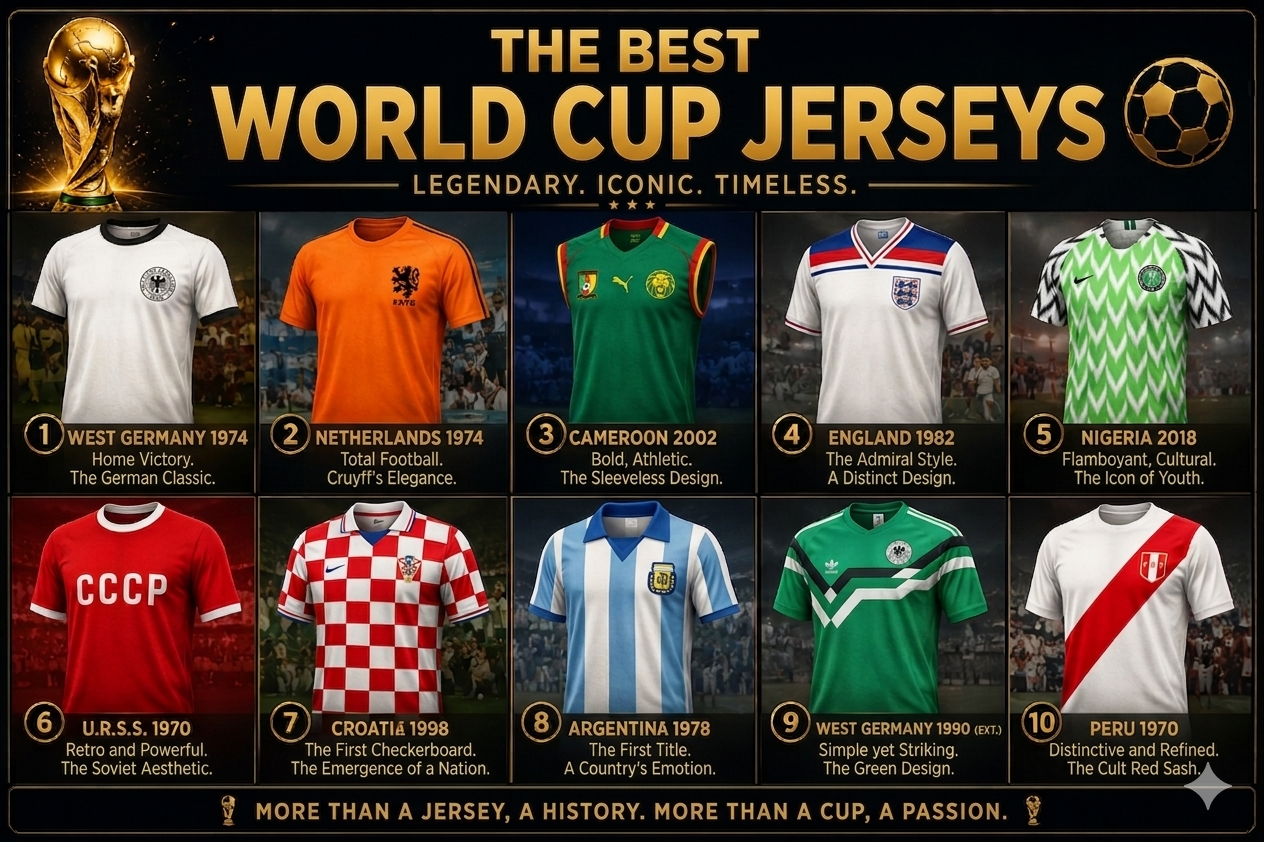
These are the best World Cup kits of all time — ranked by their design, their historical significance, and their enduring place in football culture. Whether you’re a collector, a fan reliving tournaments past, or simply someone who knows that a great football shirt is a piece of wearable history, this is the definitive list.
10. Argentina 1986 — The Sky Blue and White Stripes
Diego Maradona’s tournament. Diego Maradona’s shirt. The pale sky blue and white stripes of Argentina’s 1986 kit have become inseparable from the most dominant individual performance in World Cup history. Every photograph of the Hand of God, every freeze-frame of the Goal of the Century, features this jersey.
The 1986 kit was produced by Le Coq Sportif, and its simplicity is part of its power — thin vertical stripes, a modest collar, nothing to distract from the man wearing it. Argentina wore these stripes to the title in Mexico City on 29 June 1986, beating West Germany 3–2 in a final that Maradona, exhausted and brilliant, orchestrated from the shadows.
The retro version of Argentina’s 1986 home shirt is one of the most sought-after jerseys in the collector’s market. Adidas now produces an official retro version — available on Amazon and through specialist retailers.
Why it endures: You cannot look at this shirt without seeing Maradona. That is the definition of an iconic kit.
9. Senegal 2002 — Green Lions on Their Debut Stage
No team in World Cup history made a more dramatic entrance than Senegal in 2002. Making their first-ever appearance at the tournament, they beat the defending champions France in the opening match — one of the greatest upsets in World Cup history — and reached the quarter-finals wearing this vibrant green-trimmed white kit.
The Puma-made shirt, featuring bold green shoulder panels and a distinctive collar, became a symbol of African football’s arrival on the global stage. Papa Bouba Diop scoring that famous opening goal in Senegal’s colours launched a thousand replica orders from fans who had never previously heard of the team.
Senegal’s 2002 kit remains one of the most collectible African football shirts ever produced. Classic football shirt retailers occasionally stock originals — search Amazon for current availability.
Why it endures: Every shirt tells the story of the team that wore it. No team wore their debut more dramatically than Senegal.
8. Netherlands 1974 — Total Football, Total Orange
Total Football needed a total kit. The Netherlands’ 1974 World Cup strip — a blaze of pure Adidas orange — was as radical as the tactical system Johann Cruyff and his teammates were pioneering on the pitch. No country had ever arrived at a World Cup playing football quite like this. No country had ever arrived wearing quite this much orange.
The shirt — round collar, three white Adidas stripes on each sleeve, a shade of orange so vivid it bordered on aggressive — became one of the most recognisable in football history despite the Netherlands never winning the tournament they effectively transformed. They lost the 1974 final to West Germany 2–1, played in front of a home crowd that had come to watch Cruyff collect the trophy.
The Dutch 1974 retro kit has been periodically re-released by Adidas and remains a collector’s staple. Check Amazon for current stock.
Why it endures: Total Football is the most influential tactical philosophy in football history. This is what it looked like.
7. Italy 1982 — Azzurri Blue and the Comeback Nobody Saw Coming
Italy arrived in Spain for the 1982 World Cup having drawn all three group stage games. The Azzurri — in their classic deep blue with the distinctive collar and the Italian Football Federation crest — were dismissed by every pundit on the planet.
What followed was one of the most extraordinary knockout-stage runs in World Cup history. Paolo Rossi, scoreless through the group stage, scored six goals in three games. Italy beat Argentina. Italy beat Brazil. Italy beat West Germany 3–1 in the final. The sight of Dino Zoff — 40 years old, the oldest goalkeeper ever to play in a World Cup final — lifting the trophy in those blue shirts is one of the enduring images of the tournament.
The 1982 Italy kit is considered the finest design in Azzurri history by most Italian football historians — a masterclass in restraint that made the players look exactly what they were: world champions.
Why it endures: Sometimes a kit earns its place in history not through boldness but through the moments it witnesses.
6. Germany 2014 — The Kit That Won in Brazil
Germany’s 2014 World Cup kit was functional, elegant, and ultimately triumphant — which is to say it was very German. The white home shirt with black Adidas stripes and subtle red trim was the jersey Mario Götze wore when he controlled Schürrle’s cross on his chest and volleyed Germany into history against Argentina in the Maracanã final.
That image — Götze’s back-heel control, the volley, the net bulging — is one of the great World Cup photographs, and the Adidas-designed kit is central to it. Germany’s 2014 kit is the jersey of a team that also destroyed hosts Brazil 7–1 in the semi-final, producing the most shocking result in the history of the tournament.
The official retro version of Germany’s 2014 World Cup shirt is available on Fanatics and through Amazon’s sports merchandise section. It remains one of the best-selling retro Germany shirts in the European market.
Why it endures: It is the jersey of the last great German World Cup generation. Götze’s winner secured its place in history forever.
5. France 1998 — A Nation United in Blue
The deep navy blue of France’s 1998 World Cup shirt carries one of football’s most powerful narratives. A young, diverse, multicultural squad — built from talent from across France’s former colonies as much as from the Hexagone itself — united a nation and produced a 3–0 final demolition of Brazil on home soil.
Zinedine Zidane’s two first-half headers against Ronaldo’s Brazil, both in that dark blue Adidas shirt, remain among the most celebrated images in French sporting history. The kit — with its understated design, golden star, and the single embroidered cockerel — became the symbol of a generation.
France’s 1998 home shirt is officially the best-selling World Cup jersey in French retail history. Twenty-five years later, original match-worn versions command extraordinary prices at auction. The retro Adidas version is available on Amazon.
Why it endures: Les Bleus in 1998 weren’t just a football team. They were a statement about what France was and could be.
4. Argentina 2022 — Messi’s Coronation Kit
Few football shirts will carry the weight of narrative that Argentina’s light blue and white striped 2022 Qatar kit now carries. This is the jersey Lionel Messi wore through the most dramatic World Cup final ever played — a 3–3 draw against France resolved on penalties — to finally claim the title his career demanded.
The Adidas-designed shirt, with its clean vertical stripes and the three gold stars above the AFA crest (three stars, because 2022 was Argentina’s third title), became the fastest-selling football jersey in commercial history following the final. Photographs of Messi sitting alone in the Lusail dressing room, golden ball in hand, wearing this shirt, have already entered the canon of the greatest sports images ever taken.
The 2022 Argentina home shirt — Messi’s number 10 — is available through Fanatics, Adidas, and Amazon. It remains the best-selling football jersey in the world.
Why it endures: Messi wore this shirt when he became the greatest footballer who ever lived. It will never not sell.
3. Brazil 1994 — Five Stars in the Making
Brazil’s 1994 kit — the golden yellow home shirt produced by Umbro, with the distinctive green collar and the four-star Brazilian Football Confederation crest — was worn as the Seleção ended a 24-year wait for a World Cup title, beating Italy on penalties in the first final in tournament history to be decided by a shootout.
Romário and Bebeto — one of football’s great strike partnerships, the men who gave the world the famous baby-rocking goal celebration — wore this shirt through the entire 1994 tournament without conceding a single goal in open play. The jersey is associated with some of the most technically brilliant football Brazil produced between their 1970 and 2002 title-winning campaigns.
Brazil’s retro 1994 Umbro kit has become one of the most prized collector’s items in football shirt history. Authentic versions appear periodically at auction; replica versions can be found through specialist retailers and Amazon.
Why it endures: This is the Brazil shirt of Romário and Bebeto. That alone is enough.
2. Germany 1990 — The Diagonal and the Title
Few kit designs in World Cup history are as instantly recognisable as West Germany’s 1990 strip — the white Adidas shirt with its dramatic diagonal black, red, and yellow stripe slashing across the chest. It was bold, it was distinctive, and it belonged to the tournament’s least romantic winning team.
West Germany’s Mannschaft were efficient, organised, and ruthless in Italia 90. They beat England on penalties in the semi-final — one of the most heartbreaking nights in English football history — and then beat Argentina 1–0 in a final widely considered the worst in World Cup history. None of that diminishes the shirt, which has only grown more celebrated with time.
The 1990 West Germany kit regularly tops polls of the greatest football shirt ever designed. The Adidas retro version is one of the most frequently reprinted classic jerseys in the market — find it on Amazon.
Why it endures: The diagonal stripe is one of the great football kit design decisions. It has never been bettered.
1. Brazil 1970 — The Definitive Football Shirt
There is no debate. The greatest World Cup kit ever made is Brazil’s 1970 home jersey — the gold Umbro shirt with the deep green collar and cuffs, the blue shorts, the white socks — worn by the greatest football team ever assembled to produce the most beautiful football ever played at a World Cup.
Pelé. Jairzinho. Tostão. Rivelino. Carlos Alberto. The 1970 Brazil squad didn’t just win the World Cup — they transformed it into an art form. Their 4–1 final victory over Italy remains the standard against which every subsequent World Cup performance is measured. Carlos Alberto’s fourth goal — built from a sweeping team move that began in their own half and finished with a thunderous right-footed drive — is the greatest team goal in World Cup history.
The yellow of Brazil’s 1970 shirt is the most recognised colour in football. It has been worn ever since, through five World Cup titles and countless heartbreaks, and it still carries more weight of expectation than any other strip on the planet.
The authentic Adidas retro Brazil 1970 jersey — available in the classic gold with green trim — is the single most prized item in the football shirt collector’s market. Find it on Amazon or through Fanatics for the best available stock.
Why it endures: Because nothing in football has ever been more beautiful, before or since.
How to Build a World Cup Kit Collection
For collectors, the football shirt market has matured significantly in the last decade. A few guidelines for buying classic World Cup jerseys:
Originals vs. retros: Original match-issue shirts from pre-2000 tournaments are extraordinarily rare and expensive. Retro reproductions by the original manufacturers (Adidas, Umbro, Le Coq Sportif) are the best alternative — made to the original specifications but produced for the modern collector market.
Where to buy: Amazon carries an extensive range of retro and official replica kits across all price points. Fanatics is the official retailer for many current national team kits and stocks a solid retro range. For genuinely rare originals, Classic Football Shirts and Kitbag are the specialist marketplaces most trusted by serious collectors.
What to look for: Official licensed products from the kit manufacturer — not third-party replicas. The quality difference is significant, and original-license retros retain value where unofficial replicas do not.
Further Reading
For the stories behind the greatest kits, you need to understand the tournaments they were worn in. Start with our complete history of the FIFA World Cup (1930–2026) — the definitive account of every edition, every champion, and every defining moment.
For the full list of every World Cup winner, see our complete World Cup winners list. And for the moments these kits witnessed, read our guide to the 10 greatest World Cup upsets of all time.
For deeper reading on football’s visual and cultural history:
- “The Shirt: A History of Football’s Iconic Shirts” — various authors — The most comprehensive book on football kit design and history. Available on Amazon
- “The Ball is Round” by David Goldblatt — The definitive global history of football, covering the cultural context of every World Cup era. Available on Amazon
World Cup Tribune is the definitive English-language reference on FIFA World Cup history. Every claim in this article draws on official FIFA records, contemporaneous match reports, and verified sports journalism.