
Affiliate disclosure: World Cup Tribune participates in the Amazon Associates Programme and other affiliate programmes. We may earn a commission on qualifying purchases at no extra cost to you.
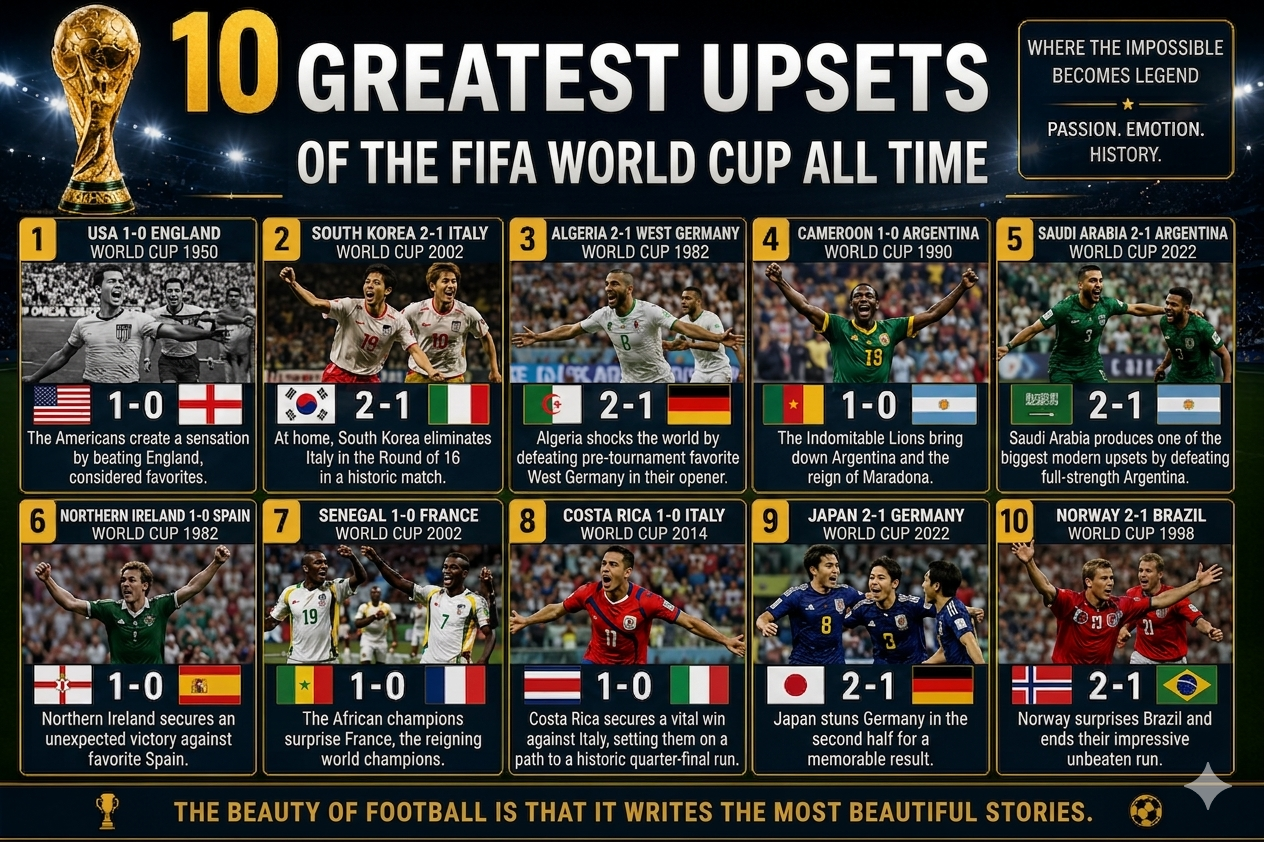
10 Greatest World Cup Upsets of All Time
The World Cup has produced more moments of collective disbelief than any other sporting event on the planet. Every four years, somewhere, a tournament favourite walks out onto a pitch and never walks back off it the same way. Reputations are made in 90 minutes. Histories are rewritten. And the teams nobody expected to win write the stories everyone remembers.
These are the ten greatest World Cup upsets of all time — ranked not just by the improbability of the result, but by its shock, its context, and its lasting place in football mythology.
10. Senegal 1–0 France (2002 Group Stage)
The defending champions. The world’s best squad. A nation expecting a coronation. Senegal were making their first-ever World Cup appearance, managed by a Frenchman, and containing precisely zero players anyone outside West Africa could name by sight.
What followed was perhaps the most one-sided scoreline in terms of expectations in World Cup group-stage history. Papa Bouba Diop’s first-half goal — fumbled in by a defender after a goalmouth scramble — gave Senegal a 1–0 win over a France side featuring Zidane, Henry, Vieira, and Barthez. France went home without scoring a single goal in the tournament.
Senegal’s run to the quarter-finals — eliminating Sweden on the “golden goal” rule before losing to Turkey — announced African football to a generation of fans. Their 2002 kit, worn during that historic campaign, remains one of the most sought-after shirts in African football history.
Why it shocks even now: The defending champions, eliminated in the group stage, beaten by a debut nation in the opening match. Nothing in football prepared anyone for it.
9. Cameroon 1–0 Argentina (1990 Group Stage)
Argentina were the reigning world champions. Diego Maradona’s squad arrived in Italy as tournament favourites with the swagger of a team that had won the previous edition in the most spectacular individual fashion imaginable.
Cameroon’s “Indomitable Lions” — featuring the 38-year-old Roger Milla, who had come out of retirement to play — reduced Argentina to a shambles. Despite finishing with nine men after two red cards, Cameroon held on for a 1–0 win. Milla, brought on as a substitute, danced around the corner flag in celebration and became a permanent fixture of World Cup iconography.
Cameroon’s run to the quarter-finals — where only a controversial penalty in extra time against England stopped them — announced sub-Saharan Africa’s arrival on the world stage.
Why it shocks even now: Defending champions beaten, nine men holding firm. The defining image of Italia 90 is Milla’s corner-flag dance — not Maradona’s wizardry.
8. North Korea 1–0 Italy (1966 Group Stage)
The Italians called it the greatest humiliation in their football history. North Korea — playing in only their first World Cup, virtually unknown outside the peninsula, with players who trained as factory workers — beat Italy 1–0 to eliminate the four-time World Cup winners from the group stage.
Pak Doo-ik scored the only goal. Italy flew home to be pelted with rotten tomatoes at the airport by furious supporters. North Korea went on to lead Portugal 3–0 in the quarter-finals before the great Eusébio produced one of the most extraordinary individual comebacks in football history, scoring four goals in a 5–3 reversal.
The footage of North Korea’s players — anonymous, joyful, running in perfect unison — remains some of the most extraordinary in World Cup history.
Why it shocks even now: Factory workers beating world champions. Even in 1966, this was incomprehensible.
7. USA 1–0 England (1950 Group Stage)
The Americans were 500/1 outsiders. England — making their first ever World Cup appearance — were considered by many the best team on earth, and were expected to cruise through the group stage on their way to the title.
The United States squad was a collection of amateurs: a dishwasher, a mailman, a hearse driver. Haitian-born Joe Gaetjens headed in the only goal. England hit the woodwork. England hit the goalkeeper. England hit everything except the back of the net. The scoreline — USA 1, England 0 — was so improbable that English newspapers assumed a typo and printed it as 10–1 to England.
This result still represents the single greatest upset in the history of international football, measured against pre-match expectation.
Why it shocks even now: The result was so impossible that journalists assumed it was a mistake. It was not a mistake.
6. West Germany 3–2 Hungary (1954 Final — “The Miracle of Bern”)
This one is unusual in the upset rankings because it happened in a final — meaning Hungary’s defeat meant the most magical team in football history never won the World Cup.
The Hungarian squad of 1950–1956 was arguably the greatest international side ever assembled. Ferenc Puskás, Sándor Kocsis, Zoltán Czibor — they had not lost in four years, had demolished England 6–3 at Wembley (England’s first home defeat), and had beaten West Germany 8–3 just two matches earlier in the same tournament.
West Germany won 3–2. Hungary hit the post twice in the final minutes. Puskás had a goal disallowed. The “Miracle of Bern” — so named for the Swiss city where the final was played — launched West Germany’s post-war identity and broke Hungary’s golden generation forever. The political upheaval of 1956 scattered those players across Europe, and the team was never reassembled.
Why it shocks even now: The greatest team ever assembled, at their absolute peak, lost the only final they ever played.
5. Algeria 2–1 West Germany (1982 Group Stage)
Algeria had never played in a World Cup. West Germany were the defending European champions and two-time World Cup winners. The Africans were given no chance whatsoever.
What followed was not just an upset but a statement of intent. Algeria played technically sophisticated, tactically disciplined football and won 2–1 in what was — for one afternoon — the biggest shock in World Cup history.
What followed the shock was more scandalous than the shock itself. In their final group game, West Germany and Austria played out a 1–0 result — the “Disgrace of Gijón” — that conveniently eliminated Algeria on goal difference. Both teams walked through the final 80 minutes without attempting to win. FIFA subsequently changed the format so that the final group games are played simultaneously.
Algeria’s 1982 kit — green, white, and dramatic — is available through specialist football shirt retailers for those who want to own a piece of the moment that changed how the World Cup was organised.
Why it shocks even now: Algeria not only beat the favourites — they forced FIFA to rewrite its rules.
4. South Korea 2–1 Germany (2018 Group Stage)
Germany were the reigning world champions. They had won four World Cups. They had destroyed hosts Brazil 7–1 in the previous tournament’s semi-final. They were, by any rational measure, one of the greatest teams in the history of the game.
South Korea were already eliminated when they met Germany in the final group game. They had nothing to play for except pride.
Two goals in injury time — from Kim Young-gwon and Son Heung-min — sent Germany home in the group stage. The images of German players, blank-faced and silent in the Kazan Arena, circled the globe in seconds. It was the first time since 1938 that a reigning world champion had been eliminated in the group stage.
Son Heung-min’s celebration — sprinting towards the corner flag while German players sank to the turf — is one of the defining images of the modern World Cup era.
Why it shocks even now: The reigning champions, out at the group stage. Again.
3. Saudi Arabia 2–1 Argentina (2022 Group Stage)
Lionel Messi. The tournament favourite. A nation preparing for his coronation as world champion after a career of near-misses. Argentina had not lost in 36 matches.
Saudi Arabia — ranked 48th in the world, managed by a Frenchman, with players who competed in a domestic league few had ever watched — led at half time. Held on. Won.
Saleh Al-Shehri and Salem Al-Dawsari scored within six second-half minutes. Argentina had three goals ruled offside in the first half. The greatest footballing nation of the last decade was beaten by a team ranked 47 places below them.
Argentina, of course, went on to win the World Cup — their third title and Messi’s first. But for 90 minutes in Lusail, football’s hierarchies were dissolved completely. The images of Saudi fans — delirious, disbelieving, united — remain the most shared images of the 2022 tournament.
Saudi Arabia’s 2022 home kit — white with a green collar — became one of the fastest-selling football shirts in history following that result. Find it on Fanatics or search Amazon for available stock.
Why it shocks even now: Messi’s Argentina, 36 games unbeaten, beaten by a team ranked 51st in the world. On the day he was supposed to begin his march to glory.
2. Uruguay 2–1 Brazil (1950 — The Maracanazo)
Two hundred thousand people packed the Maracanã. Brazil had already effectively won the tournament — they needed only a draw in the final group game to be crowned champions for the first time. The pre-match edition of the official host city newspaper had already printed the congratulations.
Uruguay won 2–1.
Alcides Ghiggia scored the winner in the 79th minute. The stadium fell silent — 200,000 people making no sound at all, which witnesses described as the most unsettling thing they had ever experienced at a sporting event. Three Brazilian players reportedly died of heart attacks on the terraces. The goalkeeper Barbosa was never forgiven by his country, spending the rest of his life blamed for the most painful moment in Brazilian football history.
The Maracanazo — named for the Maracanã — remains the defining tragedy of world football. Brazil redesigned their national kit entirely as a result, abandoning white for yellow. You can read the full story in our complete history of the FIFA World Cup.
Why it shocks even now: 200,000 people expecting a coronation. The silence of the Maracanã remains one of the great sounds in sport.
1. USA 1–0 England (1950) — The Eternal Number One
We return to Belo Horizonte, 1950. Because no upset in World Cup history — not the Maracanazo, not Saudi Arabia vs Argentina — matches the sheer statistical improbability of the United States defeating England.
England had not just invented the game. They had refused to participate in the first three World Cups because they considered the tournament beneath them. When they finally deigned to enter in 1950, the expectation — not just in England but worldwide — was that they would win it comfortably.
The American team had no professional footballers. Their preparation was minimal. Their budget was negligible. Joe Gaetjens headed in from a deflection in the 37th minute and that, impossibly, was enough.
The result was so unthinkable that the BBC broadcast no footage — because no broadcaster had thought it worth sending a camera crew. England went home. The United States celebrated a result their own country largely ignored, because association football barely existed in American sporting culture.
The complete list of World Cup winners tells the story of those who triumphed. This is the story of the day football’s founding nation fell to a team of part-time amateurs. It has never been forgotten.
The Pattern Behind Every Upset
What unites these ten moments — from Belo Horizonte to Lusail — is not luck. Every one of these upsets involved a technically prepared, tactically disciplined team that believed, completely, they could win. Luck did not beat England in 1950 or Germany in 2018. Belief did. Organisation did. The refusal to accept the narrative the world had written for them.
That is why the World Cup produces these moments more reliably than any other tournament. The compressed format, the immovable stakes, the weight of national expectation — all of it creates conditions in which the supposedly impossible becomes merely a matter of 90 minutes.
Further Reading
For the deepest accounts of these moments:
- “The Ball is Round” by David Goldblatt — The definitive global football history, covering the political and social context of every era. Available on Amazon
- “How Soccer Explains the World” by Franklin Foer — Essential for understanding how football upsets reflect broader national stories. Available on Amazon
For the complete story of how these upsets fit into the wider tapestry of World Cup history, read our complete FIFA World Cup history (1930–2026) — and see every World Cup winner to understand what these upsets cost the favourites.
World Cup Tribune is the definitive English-language reference on FIFA World Cup history. Every claim in this article draws on official FIFA records, contemporaneous match reports, and verified sports journalism.