Affiliate disclosure: World Cup Tribune participates in the Amazon Associates Programme and other affiliate programmes. We may earn a commission on qualifying purchases at no extra cost to you.
Every World Cup Winner: The Complete List (1930–2026)
In the summer of 1930, eleven nations made the journey to Montevideo. Only one would lift the trophy. Ninety-six years later, that same gold cup has passed through the hands of eight different nations — and the stories behind each victory are as dramatic as football itself.
This is the definitive
world cup winners list: every champion, every host nation, every final score, from Uruguay’s historic triumph in 1930 to Spain’s second title in 2026. Whether you’re settling a pub argument or building your football knowledge from the ground up, this is the only reference you need.
Last updated: 19 July 2026, immediately after the 2026 final.
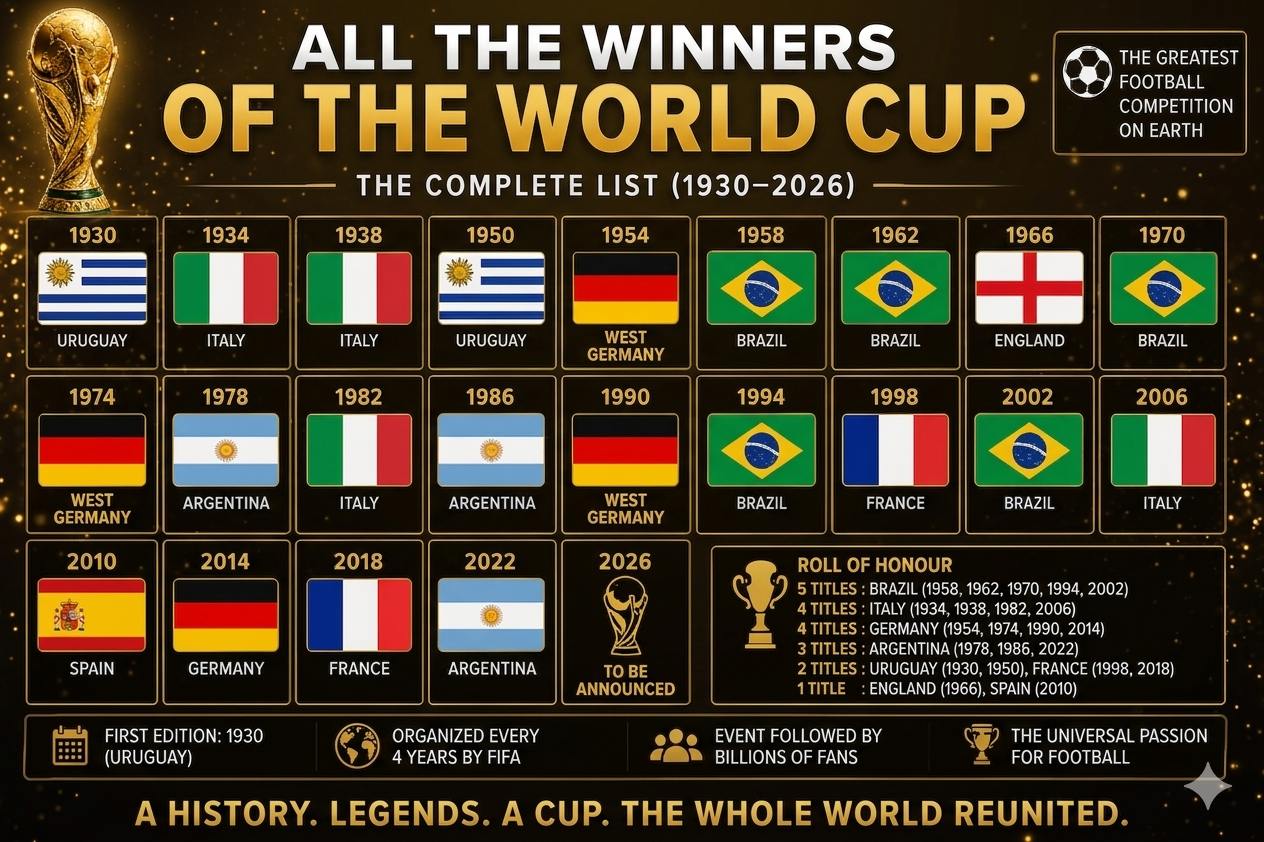
The short answer: Brazil has won the most World Cups with five titles. Germany and Italy have four each, Argentina three, and France, Uruguay and Spain two apiece. The reigning champions are
Spain, who beat Argentina 1–0 after extra time in the 2026 final at MetLife Stadium. Eight nations in total have won the tournament since 1930.
The Complete World Cup Winners List (1930–2026)
>
| Year |
Champion |
Runner-Up |
Score |
Host |
| 1930 |
Uruguay |
Argentina |
4–2 |
Uruguay |
| 1934 |
Italy |
Czechoslovakia |
2–1 (aet) |
Italy |
| 1938 |
Italy |
Hungary |
4–2 |
France |
| 1950 |
Uruguay |
Brazil |
2–1* |
Brazil |
| 1954 |
West Germany |
Hungary |
3–2 |
Switzerland |
| 1958 |
Brazil |
Sweden |
5–2 |
Sweden |
| 1962 |
Brazil |
Czechoslovakia |
3–1 |
Chile |
| 1966 |
England |
West Germany |
4–2 (aet) |
England |
| 1970 |
Brazil |
Italy |
4–1 |
Mexico |
| 1974 |
West Germany |
Netherlands |
2–1 |
West Germany |
| 1978 |
Argentina |
Netherlands |
3–1 (aet) |
Argentina |
| 1982 |
Italy |
West Germany |
3–1 |
Spain |
| 1986 |
Argentina |
West Germany |
3–2 |
Mexico |
| 1990 |
West Germany |
Argentina |
1–0 |
Italy |
| 1994 |
Brazil |
Italy |
0–0 (3–2 pens) |
USA |
| 1998 |
France |
Brazil |
3–0 |
France |
| 2002 |
Brazil |
Germany |
2–0 |
Japan/South Korea |
| 2006 |
Italy |
France |
1–1 (5–3 pens) |
Germany |
| 2010 |
Spain |
Netherlands |
1–0 (aet) |
South Africa |
| 2014 |
Germany |
Argentina |
1–0 (aet) |
Brazil |
| 2018 |
France |
Croatia |
4–2 |
Russia |
| 2022 |
Argentina |
France |
3–3 (4–2 pens) |
Qatar |
| 2026 |
Spain |
Argentina |
1–0 (aet) |
USA/Canada/Mexico |
*The 1950 tournament used a final round-robin group rather than a single final match. Uruguay’s decisive victory over Brazil in the final game effectively served as the championship decider.
World Cup Wins by Country: The All-Time Rankings
Eight nations have won the FIFA World Cup. Here is the complete ranking by number of titles:
| Rank |
Nation |
Titles |
Years |
| 1 |
Brazil |
5 |
1958, 1962, 1970, 1994, 2002 |
| 2 |
Germany |
4 |
1954, 1974, 1990, 2014 |
| 3 |
Italy |
4 |
1934, 1938, 1982, 2006 |
| 4 |
Argentina |
3 |
1978, 1986, 2022 |
| 5 |
France |
2 |
1998, 2018 |
| 5 |
Spain |
2 |
2010, 2026 |
| 5 |
Uruguay |
2 |
1930, 1950 |
| 8 |
England |
1 |
1966 |
Brazil stands alone at the summit with five World Cup titles — the only nation ever to compete in every single edition of the tournament. Their 1970 squad remains the benchmark by which every subsequent generation is measured. Germany and Italy share second place with four titles each, though their paths to glory look entirely different: Germany’s triumphs span six decades of relentless tactical evolution, while Italy’s victories cluster around two golden generations separated by 44 years.
The Stories Behind the Champions
Uruguay (1930, 1950) — The Founding Dynasty
Few remember that Uruguay arrived at the first World Cup as the reigning Olympic champions — twice over, having won in 1924 and 1928. They were the undisputed best team on the planet. What followed was confirmation of a fact the world already knew, though it took 13 European nations making the two-week boat journey to South America to make it official.
Their second triumph in 1950 is the more remarkable story. Facing Brazil in the decisive match at the Maracanã — in front of what remains the largest crowd ever to watch a football match — they produced
one of the greatest upsets in World Cup history. The
Maracanazo broke an entire nation’s heart and secured Uruguay a second gold.
If you want to understand Uruguay’s remarkable World Cup legacy, Jonathan Wilson’s
The Anatomy of England and David Goldblatt’s
The Ball is Round both offer superb context. Both are available on Amazon.
Italy (1934, 1938, 1982, 2006) — Four Stars, Two Eras
Italy’s first two World Cup triumphs, in 1934 and 1938, arrived under the politically charged atmosphere of Mussolini’s regime — a context that complicates but cannot erase the genuine quality of those squads. Giuseppe Meazza was the era’s defining player: technically brilliant, impossibly composed.
The 1982 triumph is the one Italians talk about most.
La Nazionale arrived in Spain having drawn all three group-stage games, eliminated by most pundits as early as the group phase. What followed was a stunning knockout-stage run — beating Argentina and Brazil before dismantling West Germany 3–1 in the final. Paolo Rossi, scoreless through the group stage, scored six goals in three games. Football’s capacity for narrative reinvention has rarely been more dramatically demonstrated.
Germany (1954, 1974, 1990, 2014) — The Relentless Standard
West Germany’s 1954 victory over the mighty Hungarian side of Puskás and Czibor remains one of the greatest upsets in final history — the “Miracle of Bern.” Hungary had not lost in four years and were considered the finest team ever assembled. They lost 3–2.
Germany’s 2014 title, sealed by Mario Götze’s extra-time winner against Argentina in Brazil, completed a transformation from the stereotyped defensive machine to one of the most technically refined sides in World Cup history. Their 7–1 semi-final destruction of host nation Brazil — the
Mineirazo — may be the single most shocking result in World Cup history.
Brazil (1958, 1962, 1970, 1994, 2002) — Five Stars, One Legend
No player has defined a nation’s World Cup legacy more completely than Pelé defined Brazil’s. He won his first World Cup at 17 years old, scoring twice in the final against Sweden in 1958. He was 29 — and at his absolute peak — when the 1970 squad produced football so beautiful it is still studied, frame by frame, by coaches around the world.
That squad wore the iconic yellow and blue kit that has become the most recognisable in football history. Brazil retro kits from 1970 remain among the best-selling football shirts on the market — and for good reason. The authentic Adidas retro version is available via Amazon for collectors and supporters who want to own a piece of that legacy.
Brazil’s fifth title in 2002 — led by Ronaldo R9’s extraordinary return from career-threatening illness — belongs in a category of its own. You can read the full story in our profile of
the 2002 World Cup and Brazil’s fifth title.
Argentina (1978, 1986, 2022) — Three Titles, Two Icons
Argentina’s three World Cup victories are inseparable from the two greatest players in football history. The 1978 triumph, on home soil and in complicated political circumstances under a military junta, belonged to Mario Kempes. The 1986 edition belonged entirely to Diego Maradona — the greatest individual tournament performance in the history of the competition. The 2022 Qatar triumph, in the most dramatic final ever played, was Lionel Messi’s crowning moment.
Argentina came within one match of back-to-back titles in 2026, beating England 2–1 in the semifinal before losing 1–0 to Spain in extra time. Reduced to ten men after Enzo Fernández’s 90th-minute red card, they failed to register a shot in normal time. At 39, Messi has not confirmed whether it was his final World Cup.
The
Maradona vs Messi World Cup legacy debate will run for generations. What is beyond debate is that Argentina’s 2022 retro and match kits are currently the most sought-after shirts in world football, available through Fanatics and Amazon.
France (1998, 2018) — The Modern Superpower
France’s 1998 triumph on home soil, engineered by Zinedine Zidane’s towering presence in midfield, announced a new superpower in world football. Their 3–0 demolition of a Ronaldo-afflicted Brazil in the final was as clinical as any World Cup final performance.
Twenty years later, Didier Deschamps — who lifted the 1998 trophy as captain — guided a new generation of French talent to a second title in Russia. Kylian Mbappé became only the second teenager, after Pelé, to score in a World Cup final. France’s squad, built on the extraordinary depth of their academy system, represents the dominant force entering the 2026 tournament.
England (1966) — The One and Only
England’s 1966 triumph remains the defining moment of the nation’s football history — and the most painful reminder of what has not been achieved since. Geoff Hurst’s hat-trick in the Wembley final against West Germany, including the still-debated “did it cross the line?” third goal, secured a 4–2 victory that an entire nation has been trying to repeat for 60 years.
Spain (2010) — Two Eras of Total Domination
Spain’s 2010 triumph in South Africa was the culmination of the finest era of international football any nation has produced. Built on Pep Guardiola’s Barcelona, the
tiki-taka system — relentless short passing, suffocating pressing, territorial domination — won them the European Championship in 2008 and 2012 on either side of their World Cup. Andrés Iniesta’s extra-time winner against the Netherlands completed the set.
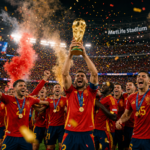
Sixteen years later, a completely rebuilt Spain did it again. Luis de la Fuente’s side went unbeaten through the 2026 tournament, knocking out France 2–0 in the semifinal before beating holders Argentina 1–0 in the final at MetLife Stadium. Substitute Ferran Torres scored the only goal in the 106th minute, and Spain became the first nation to convert every final it has ever reached into a title — two from two. Rodri took the Golden Ball, Unai Simón the Golden Glove, and 19-year-old defender Pau Cubarsí the Young Player award. Read the
full 2026 final report here.
Key Facts About World Cup Champions
The most successful continent: Europe and South America share the honours almost equally. Europe has won 13 tournaments; South America 10. No team from Africa, Asia, or North America has ever won the World Cup, and the 2026 edition hosted across North America did not break that pattern — Spain’s victory extended Europe’s lead. Only three nations from outside those two confederations have even reached a semifinal: the United States (1930), South Korea (2002), and Morocco (2022). See our
full ranking of World Cup semifinal appearances for the complete picture.
Home advantage: Five of the 23 completed World Cups have been won by the host nation — Uruguay (1930), Italy (1934), England (1966), West Germany (1974), and France (1998). No host nation has won since.
Consecutive titles: Brazil (1958 and 1962) and Italy (1934 and 1938) are the only nations to have won back-to-back World Cups.
The longest wait: Uruguay last won in 1950 — a 76-year gap and counting. England’s wait since 1966 has now passed six decades, and their 2026 run ended in a semifinal defeat to Argentina followed by a 6–4 third-place win over France. The weight of history bears down on both nations every four years.
The 2026 World Cup: How Spain Won It
The 2026 FIFA World Cup was the largest in history — 48 teams across 16 cities in the United States, Canada, and Mexico — and it ended with Spain lifting a second trophy sixteen years after their first.
Spain went through the tournament unbeaten. They beat France 2–0 in the semifinal in Dallas, while holders Argentina edged England 2–1 in Atlanta to set up a final between the reigning European and South American champions at MetLife Stadium on 19 July 2026.
The final itself was tense and goalless through 90 minutes. Argentina lost Enzo Fernández to a second yellow card in the 90th minute, and Spain made the extra man count: substitute Ferran Torres struck in the 106th minute after Nico Williams headed Pedro Porro’s cross into his path. Spain finished the match having out-shot Argentina 20–3, with Argentina failing to register a single shot in normal time — an extraordinary statistic for a World Cup final.
2026 tournament awards and records:
- Golden Ball: Rodri (Spain)
- Golden Boot: Kylian Mbappé (France), 10 goals — the first player to win it twice in a row
- Golden Glove: Unai Simón (Spain)
- Young Player: Pau Cubarsí (Spain)
- Fair Play Award: Netherlands
Two records fell along the way. Mbappé passed Lionel Messi to become the all-time leading scorer in World Cup history with 22 goals, achieved during France’s wild 6–4 third-place defeat to England — the first World Cup match with ten or more goals since 1982. And at 65, Spain coach Luis de la Fuente became the oldest manager ever to win the tournament.
Read our
full match report from the 2026 final.
What the 2026 Result Changes in the Record Books
Spain’s win reshapes several all-time lists:
- Spain moves from one title to two, joining France and Uruguay on the second tier of the honours board
- Spain becomes the only nation with a perfect record in World Cup finals — two appearances, two titles
- Europe extends its lead over South America to 13 titles against 10
- Argentina become the first defending champions to reach and lose the following final since Brazil in 1998
- The host-nation drought continues: no host has won since France in 1998, and the 2026 co-hosts did not reach the semifinals
For everything you need to know about the upcoming tournament — venues, format, qualified teams, and how to watch — read our
complete report on the 2026 World Cup final.
Further Reading
The stories behind every World Cup champion deserve more than a table and a paragraph. These books offer the deepest dives available:
- “The Ball is Round” by David Goldblatt — The definitive global history of football, including every World Cup era. Available on Amazon
- “The World Cup: The Complete History” by Terry Crouch — A comprehensive tournament-by-tournament account, ideal for reference. Available on Amazon
- “How to Watch the World Cup” by Richard Henshaw — For the 2026 edition specifically. Available on Amazon
For the complete story of every era — from Uruguay’s founding triumph to Argentina’s 2022 penalty shootout heroics — read our
complete history of the FIFA World Cup (1930–2026).
World Cup Tribune is the definitive English-language reference on FIFA World Cup history. Every claim in this article is drawn from official FIFA records and verified sports journalism sources.
Explore More World Cup History