

Affiliate disclosure: World Cup Tribune participates in the Amazon Associates Programme and other affiliate programmes. We may earn a commission on qualifying purchases at no extra cost to you.
World Cup 2026: The Complete Guide (Hosts, Venues, Teams & How to Watch)
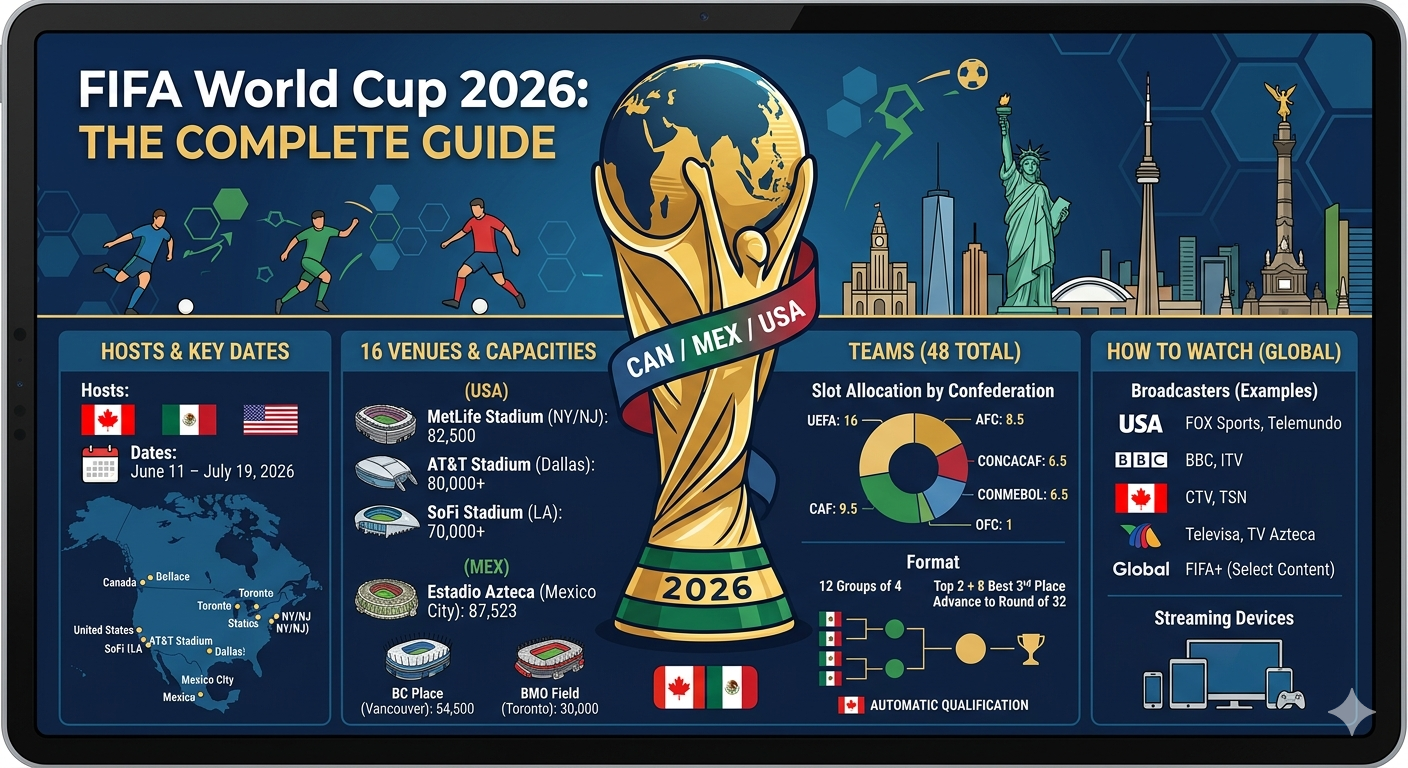
The 2026 FIFA World Cup is the largest, most ambitious edition of football’s greatest tournament ever staged. Spread across three nations, sixteen cities, and a continent, it marks the first time 48 teams will compete for the trophy — a 50% expansion from the 32-team format that has defined the tournament since 1998. The final will be played at MetLife Stadium in East Rutherford, New Jersey, just across the river from New York City, on 19 July 2026.
This is your complete guide to the 2026 World Cup — everything you need to know about the hosts, the venues, the format, the qualified teams, and how to follow every match wherever you are in the world.
The Basics: Dates, Hosts, and Format
Tournament dates: 11 June – 19 July 2026
Host nations: United States, Canada, Mexico (the first World Cup ever co-hosted by three nations)
Teams: 48 (expanded from 32)
Matches: 104 (up from 64 in 2022)
Host cities: 16 across the three nations
Final venue: MetLife Stadium, East Rutherford, New Jersey (capacity: 82,500)
The expanded 48-team format introduces a new group-stage structure: 12 groups of 4 teams, with the top two from each group plus the eight best third-placed teams advancing to a 32-team knockout round. This means every nation that qualifies is guaranteed at least three group-stage matches before the knockout rounds begin.
The Host Cities and Venues
The 2026 World Cup is played across 16 cities in three countries — the most geographically dispersed tournament in history.
United States (11 venues)
| City | Stadium | Capacity |
|---|---|---|
| New York / New Jersey | MetLife Stadium (Final venue) | 82,500 |
| Los Angeles | SoFi Stadium | 70,240 |
| Dallas | AT&T Stadium | 80,000 |
| San Francisco Bay Area | Levi’s Stadium | 68,500 |
| Miami | Hard Rock Stadium | 65,326 |
| Seattle | Lumen Field | 68,740 |
| Boston | Gillette Stadium | 65,878 |
| Atlanta | Mercedes-Benz Stadium | 71,000 |
| Houston | NRG Stadium | 72,220 |
| Kansas City | Arrowhead Stadium | 76,416 |
| Philadelphia | Lincoln Financial Field | 69,176 |
Canada (2 venues)
| City | Stadium | Capacity |
|---|---|---|
| Toronto | BMO Field | 45,736 |
| Vancouver | BC Place | 54,500 |
Mexico (3 venues)
| City | Stadium | Capacity |
|---|---|---|
| Mexico City | Estadio Azteca | 87,523 |
| Guadalajara | Estadio Akron | 49,850 |
| Monterrey | Estadio BBVA | 53,500 |
The Estadio Azteca in Mexico City holds a unique place in World Cup history — it will become the first stadium to host World Cup matches in three separate tournaments (1970, 1986, and 2026), including Maradona’s Hand of God and Goal of the Century in 1986.
The Qualified Teams
The 2026 World Cup features 48 nations — the most in the tournament’s 96-year history. Qualification spots are distributed across FIFA’s six confederations:
| Confederation | Teams Qualified | Notable entrants |
|---|---|---|
| UEFA (Europe) | 16 | France, Germany, Spain, England, Portugal |
| CONMEBOL (South America) | 6 | Argentina (holders), Brazil, Colombia |
| CAF (Africa) | 9 | Morocco, Senegal, Nigeria |
| AFC (Asia) | 8 | Japan, South Korea, Saudi Arabia |
| CONCACAF (North/Central America) | 6+3 hosts | USA, Canada, Mexico (automatic) |
| OFC (Oceania) | 1 | Australia |
| Inter-confederation playoffs | 2 | TBD |
Argentina enter as defending champions, seeking to become the first nation to win back-to-back World Cups since Brazil in 1958 and 1962. France are the tournament favourites according to most early predictions, with Kylian Mbappé entering his prime years and a squad of extraordinary depth. Brazil return under new management determined to end a 24-year wait for a sixth star.
The Favourites: Who Will Win in 2026?
France — The Bookmakers’ Choice
France arrive in North America with perhaps the most talented squad in their history. Kylian Mbappé — who scored in the 2018 and 2022 finals — will be 27, at the absolute peak of his powers. Around him, Antoine Griezmann continues to provide experience, while a generation of players from France’s extraordinary academy system have reached international maturity.
France won in 2018 and finished runners-up in 2022 after one of the most remarkable final comebacks in tournament history. They are the team everyone else must beat.
Argentina — Holders and Contenders
Lionel Messi has confirmed his intention to play at 2026, which would make him 38 during the tournament. If Argentina are to defend their title, Messi’s influence will be decisive — but the supporting cast that won in Qatar, including Julián Álvarez and Rodrigo de Paul, remains formidable. Argentina are the most dangerous team in any bracket they enter.
Brazil — Five Stars and Counting
Brazil’s last World Cup title came in 2002. The Seleção have reached the quarter-finals or further in every tournament since, but converting potential into the trophy has eluded a generation of brilliant players. With Vinícius Júnior, Rodrygo, and Endrick — one of the most exciting young strikers in world football — Brazil’s 2026 squad could finally bridge the gap.
England — 60 Years of Hurt
England last won the World Cup in 1966 at Wembley. In 2026, they arrive with arguably the deepest squad since that golden generation — Bellingham, Saka, Foden, Kane — and the tactical maturity that reached the semi-finals in 2018 and the final of Euro 2020. The question, as always, is whether the psychological weight of expectation can be managed.
Germany — Rebuilding with Purpose
Germany were eliminated in the group stage in both 2018 and 2022 — the worst back-to-back performances by a major nation in modern World Cup history. Under Julian Nagelsmann, a young, fast, technically refined squad is being rebuilt. By 2026, players like Florian Wirtz and Jamal Musiala will have four years of senior international experience. Germany are not favourites, but they are never irrelevant.
The New Format Explained
The 48-team format is the most significant structural change to the World Cup since 1998, when the tournament expanded from 24 to 32 teams. Here is how it works:
Group stage: 12 groups of 4 teams play a round-robin. The top two from each group (24 teams) plus the eight best third-placed teams (8 teams) advance. That gives 32 teams in the knockout round.
Knockout round: Standard single-elimination from the Round of 32 through to the final, played at MetLife Stadium on 19 July.
The key change: Every qualified nation is guaranteed at least three matches. In the previous 32-team format, third-placed group finishers went home. Now, the best eight third-placed teams survive. This rewards group-stage performance while giving more nations a genuine chance.
Critics of the expansion argue it dilutes quality and increases the risk of meaningless matches. Supporters argue it gives football’s growing nations — from Africa, Asia, and the Americas — a fairer representation. The 2026 tournament will settle the argument in practice.
How to Watch the 2026 World Cup
Official Broadcasters
Broadcasting rights vary significantly by country. The key rights holders for the 2026 tournament include:
- USA: Fox Sports and Telemundo (English and Spanish respectively)
- UK: BBC and ITV (free-to-air)
- Canada: TSN and CTV
- Australia: SBS (free-to-air)
- France: TF1 and beIN Sports
- Germany: ARD and ZDF (free-to-air)
- Spain: RTVE (free-to-air)
- Morocco: 2M (free-to-air)
Watching From Abroad
If you’re travelling or living outside your home country during the tournament, a reliable VPN (Virtual Private Network) lets you access your home broadcaster’s stream from anywhere in the world. Services like ExpressVPN and NordVPN are consistently rated the best options for streaming sports content reliably — both offer 30-day money-back guarantees if you want to test them for the tournament.
How to Travel to the 2026 World Cup
The 2026 World Cup is the first to be hosted across North America since USA 1994 — and the logistics of travelling between 16 cities across three countries require planning.
Key travel considerations:
- Visa requirements: Citizens of many countries will need visas for the USA, Canada, and/or Mexico. Check requirements for all three nations if you plan to attend matches in multiple host cities.
- Internal flights: The distances between host cities are enormous by European standards. Dallas to Vancouver, for example, is a 3.5-hour flight. Book early.
- Hotels: Major cities like New York, Los Angeles, and Miami will see extraordinary demand during match weeks. Booking.com currently offers the widest inventory for host cities — book 6–12 months in advance for the best rates near stadiums.
The best host cities for atmosphere:
- Mexico City — The Estadio Azteca, 87,000 fans, and one of football’s greatest stadium atmospheres on earth. Find hotels near Estadio Azteca on Booking.com
- New York / New Jersey — The final. MetLife Stadium. Need nothing else be said. Find hotels near MetLife Stadium on Booking.com
- Los Angeles — SoFi Stadium in the entertainment capital of the world. Find hotels in Los Angeles on Booking.com
The 2026 World Cup in Historical Context
The 2026 tournament is the 23rd edition of the FIFA World Cup, and it arrives at a moment of genuine transition for the global game. The expansion to 48 teams, the three-nation co-hosting model, and the North American setting all mark a deliberate shift towards football’s next frontier.
For everything that has come before — the 92 years of World Cup history from Uruguay 1930 to Qatar 2022 — read our complete history of the FIFA World Cup. And for a reminder of what is at stake for the defending champions, see our complete list of World Cup winners.
The 2026 World Cup kit releases are already generating significant attention. Argentina’s defence-of-title shirt, France’s new away strip, and Brazil’s rumoured third kit are among the most anticipated in years. As official kits are confirmed, you’ll find them on Fanatics — currently the most reliable source for official national team merchandise in North America. Our guide to the best World Cup kits of all time puts the 2026 releases in their historical context.
Essential 2026 World Cup Reading
With the tournament on the horizon, these are the books worth reading before the first whistle in June:
- “The Ball is Round” by David Goldblatt — The definitive history of football, covering every World Cup era. Essential context for understanding what 2026 represents. Available on Amazon
- “How Soccer Explains the World” by Franklin Foer — Still the best single book on football’s cultural and political dimensions globally. Available on Amazon
- “The United States of Soccer” by Phil West — The definitive account of how football grew in North America, essential reading before a North American World Cup. Available on Amazon
World Cup Tribune is the definitive English-language reference on FIFA World Cup history. Every claim in this article draws on official FIFA records, contemporaneous match reports, and verified sports journalism.
Please enter product(-s) ASIN(-s)!Read More
- The Complete History of the FIFA World Cup (1930–2026)
- Every World Cup Winner (1930–2026)
- The 10 Greatest Goals in World Cup History
- Maradona 1986: The Hand of God and the Goal of the Century
- Best World Cup Books of All Time

- Configuration: 7 stickers per pack 50 packs per Box
- OFFICIAL 2026 FIFA WORLD CUP STICKER COLLECTION – Celebrate the world’s biggest tournament with the only officially lice…
- BOX OF 50 STICKER PACKS – Perfect for collectors looking to kickstart or complete their album. Each box includes 50 seal…

I’m not that much of a online reader to be honest but
your sites really nice, keep it up! I’ll go ahead and bookmark your site to
come back in the future. All the best