
This post contains affiliate links. If you purchase through these links, we may earn a small commission at no extra cost to you.
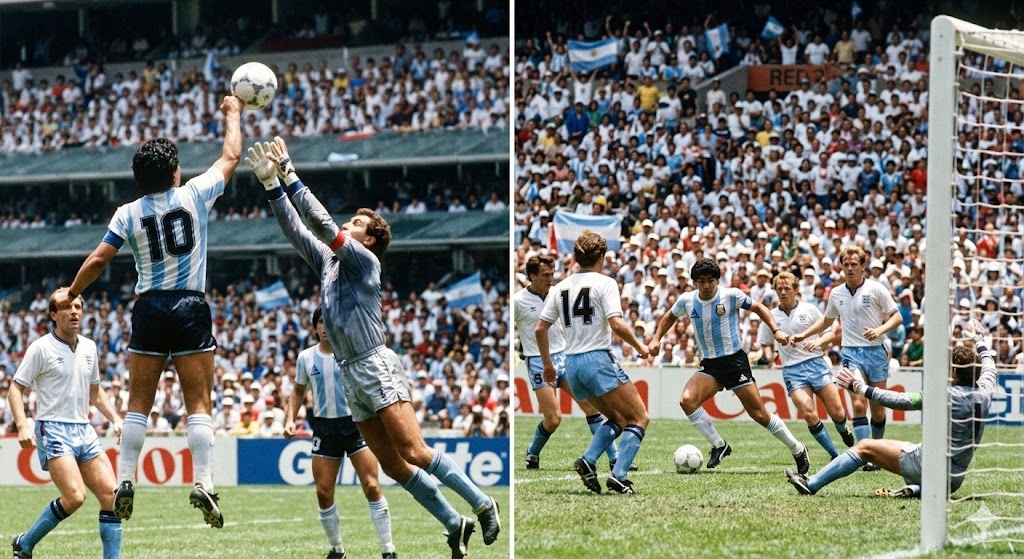
On June 22, 1986, in the Estadio Azteca in Mexico City, Diego Maradona produced two of the most famous moments in the history of sport — within four minutes of each other. One was a blatant act of cheating that he later blamed on “the hand of God.” The other was a solo run from inside his own half that left five England defenders and the goalkeeper helpless, ending with the ball in the back of the net.
Together, they defined the 1986 FIFA World Cup. Together, they defined Diego Maradona. This is the complete story of that extraordinary afternoon — and why, nearly four decades later, it still divides opinion and commands reverence in equal measure.
The 1986 World Cup: Maradona’s Stage
The 1986 FIFA World Cup in Mexico was, from the first whistle, Diego Maradona’s tournament. The 25-year-old Argentine captain had been building towards this moment his entire life. He had been left out of the 1978 World Cup squad — too young at 17. He had been a peripheral figure in Spain in 1982, famously red-carded in a group game against Brazil after a violent lunge at Batista.
In Mexico, there were no distractions and no excuses. Argentina’s entire identity — their formations, their tactics, their chances of success — was built around one man. Maradona wore the number 10 shirt, captained the side, and delivered performances of such sustained brilliance that the tournament is still remembered, first and foremost, as his.
He scored five goals and created five more across the tournament. He covered extraordinary distances in every game, pressing from the front and orchestrating from deep. But it was the quarter-final against England — charged with political tension following the Falklands War just four years earlier — that produced the two moments that would outlast every other memory of his career.
Argentina vs. England: The Political Context
To understand the Argentina–England quarter-final, you need to understand what the match meant beyond football. The Falklands War had ended in June 1982 — just four years before this game. 649 Argentine and 255 British soldiers had died in a conflict that left deep wounds in both nations.
FIFA had kept the teams apart throughout the group stage. When the draw placed them in the same quarter-final, football became the surrogate for everything that remained unresolved between the two countries. The Argentine football federation had formally requested that the match not be played. FIFA refused.
England’s players insisted the political context was irrelevant — that this was just a football match. The Argentine players, and Maradona especially, saw it differently. In his autobiography, he described the match as “a confrontation of two peoples rather than two football teams.”
On June 22, 1986, 114,580 people filled the Estadio Azteca. The temperature on the pitch was above 40 degrees Celsius. The referee was Ali Bennaceur of Tunisia. And in the 51st minute, football history was made twice.
The Hand of God — 51st Minute
The sequence began when England midfielder Steve Hodge, under pressure, mishit a backpass towards goalkeeper Peter Shilton. The ball looped high into the air. Maradona — 5ft 5in — sprinted towards it alongside the 6ft 1in Shilton.
What happened next was captured clearly by every camera at the ground. Maradona punched the ball into the net with his left fist. Shilton immediately protested. England’s players surrounded the referee, pointing at their hands. Maradona wheeled away in celebration, arms outstretched, glancing over his shoulder to see if Bennaceur would allow it.
He did. The goal stood.
After the game, Maradona was asked directly whether he had handled the ball. His answer became one of the most famous quotes in football history:
“A little with the head of Maradona and a little with the hand of God.”
It was a deflection, a denial, and a provocation all at once — delivered with the same instinctive genius that characterised everything Maradona did on a football pitch. Twenty years later, in his autobiography, he was more direct: “I was waiting for my teammates to embrace me and no one came. I told them: ‘Come hug me or the referee isn’t going to allow it.'”
The Hand of God goal remains one of the most controversial moments in World Cup history — a deliberate act of cheating that decided a quarter-final at the sport’s most prestigious tournament. It also, inadvertently, set the stage for something miraculous.
The Goal of the Century — 54th Minute
Three minutes and fifty-seven seconds after the Hand of God, Diego Maradona received the ball in his own half and produced what FIFA voters would later name the Goal of the Century.
The sequence lasted 10.9 seconds from the moment Maradona received Héctor Enrique’s pass 57 metres from goal to the moment the ball crossed the England line. In those 10.9 seconds, he touched the ball eleven times, covered 60 metres, and beat six opponents — Peter Beardsley, Peter Reid, Terry Butcher (twice), Terry Fenwick, Terry Butcher again, and finally goalkeeper Peter Shilton — before rolling the ball into the empty net.
Let’s break down every touch:
- Touch 1: Receives from Enrique in Argentina’s own half, back to goal, surrounded by England players
- Touch 2–3: Turns past Beardsley with two sharp touches, accelerating towards the halfway line
- Touch 4: Past Reid, who dives in and misses completely
- Touch 5–6: Cuts inside Fenwick, who fouls him but the referee plays on
- Touch 7–8: Past Butcher’s desperate lunge with a body swerve that seems to defy physics
- Touch 9–10: Around Shilton, who has committed to diving at his feet
- Touch 11: Rolls the ball into the empty net with his left foot
Commentator Victor Hugo Morales, calling the game in Spanish for Argentine radio, delivered what many consider the greatest piece of football commentary ever recorded. As Maradona began his run, Morales abandoned all professional restraint:
“Cosmic kite, what planet did you come from? To leave in your wake so many Englishmen, to make the whole country a clenched fist crying out for Argentina? Barrilete cósmico — you make me cry. Thank you, Diego, thank you. Football greatness. Of all time.”
In the English commentary box, Barry Davies simply said: “You have to say that is magnificent.”
England pulled one back through Gary Lineker — his sixth goal of the tournament — but Argentina held on to win 2–1. Maradona had won a World Cup quarter-final almost entirely by himself, producing one of the most immoral and one of the most brilliant goals ever scored in the same match.
Argentina’s Road to the 1986 World Cup Title
The quarter-final against England was the peak of Maradona’s individual brilliance, but Argentina still had two games to play. In the semi-final, they faced Belgium — and Maradona scored twice in a 2–0 win, including another extraordinary solo goal that echoed the Goal of the Century in its directness and pace.
The final on June 29 brought West Germany to the Estadio Azteca. Argentina led 2–0 through José Luis Brown and Jorge Valdano. West Germany fought back to level at 2–2 through Karl-Heinz Rummenigge and Rudi Völler — the only World Cup Final comeback from two goals down in the tournament’s history up to that point.
With six minutes remaining, Maradona delivered the decisive moment. Not with a goal — but with a pass. His perfectly weighted through-ball split the West German defence and found Jorge Burruchaga in space, who composed himself and finished to make it 3–2. Argentina held on. Maradona lifted the World Cup trophy, and the greatest individual World Cup performance in history was complete.
| Stage | Opponent | Score | Maradona contribution |
|---|---|---|---|
| Group Stage | South Korea | 3–1 | 1 goal, 2 assists |
| Group Stage | Italy | 1–1 | 1 goal |
| Group Stage | Bulgaria | 2–0 | 1 assist |
| Round of 16 | Uruguay | 1–0 | 1 assist |
| Quarter-final | England | 2–1 | 2 goals (Hand of God + Goal of the Century) |
| Semi-final | Belgium | 2–0 | 2 goals |
| Final | West Germany | 3–2 | 1 decisive assist (Burruchaga’s winner) |
The Goal of the Century: How It Was Voted
In 2002, FIFA invited fans around the world to vote for the greatest goal in World Cup history in celebration of the tournament’s centenary. Over 1 million votes were cast. Maradona’s second goal against England won with 41% of the total vote — more than double the second-place entry.
The title “Goal of the Century” is officially recognised by FIFA. A bronze plaque commemorating both goals is displayed at the Estadio Azteca in Mexico City, where the 2026 World Cup Final will also be played.
Recommended Books About Maradona and the 1986 World Cup
If the 1986 World Cup and Maradona’s extraordinary story have inspired you to read further, these are the best books available:
- “El Diego: The Autobiography of the Legendary Diego Maradona” — Maradona’s own account of the 1986 World Cup, including his unfiltered version of both goals against England. Unmissable. Available on Amazon.
- “Maradona: The Hand of God” by Jimmy Burns — The most authoritative biography of Maradona in the English language, with meticulous reporting on his 1986 campaign and its political context. Available on Amazon.
- “The Ball is Round: A Global History of Football” by David Goldblatt — Contains the finest long-form account of the 1986 World Cup ever written, with Maradona’s quarter-final described in unforgettable detail. Available on Amazon.
Frequently Asked Questions
What was the Hand of God goal?
The Hand of God was a goal scored by Diego Maradona against England in the 1986 World Cup quarter-final on June 22, 1986. Maradona punched the ball into the net with his left fist in the 51st minute. The referee did not see it and the goal stood. After the match, Maradona said it was scored “a little with the head of Maradona and a little with the hand of God.”
What was the Goal of the Century?
The Goal of the Century was Maradona’s second goal against England in the same match. He received the ball in his own half, dribbled past five England outfield players and the goalkeeper over 60 metres in 10.9 seconds, and rolled the ball into the empty net. FIFA officially named it the Goal of the Century after a worldwide fan vote in 2002.
Did Maradona ever apologise for the Hand of God?
Maradona never formally apologised to England for the Hand of God goal. In his 2000 autobiography, he described it as a deliberate act: “I was waiting for my teammates to embrace me and no one came. I told them: ‘Come hug me or the referee isn’t going to allow it.'” He viewed it partly as revenge for the Falklands War and never expressed regret.
Who scored in the 1986 World Cup Final?
Argentina beat West Germany 3–2 in the 1986 World Cup Final. Argentina’s goals were scored by José Luis Brown, Jorge Valdano, and Jorge Burruchaga (winner in the 84th minute, assisted by Maradona). West Germany’s goals came from Karl-Heinz Rummenigge and Rudi Völler.
How many goals did Maradona score at the 1986 World Cup?
Maradona scored 5 goals and provided 5 assists at the 1986 World Cup — a total of 10 goal involvements in 7 games. He won the Golden Ball as the tournament’s best player and is widely considered to have delivered the greatest individual World Cup performance in history.
Where was the 1986 World Cup held?
The 1986 FIFA World Cup was held in Mexico from May 31 to June 29, 1986. Mexico stepped in as host after Colombia withdrew in 1983. The final was played at the Estadio Azteca in Mexico City before 114,600 spectators.
The Legacy of June 22, 1986
Diego Maradona died on November 25, 2020. He was 60 years old. Within hours, tributes poured in from every corner of the football world. But almost every tribute — from Pelé, from Cristiano Ronaldo, from Lionel Messi — referenced the same afternoon in Mexico City, the same two goals, the same extraordinary duality of a man capable of the most dishonest and the most beautiful things in the same four minutes.
The Hand of God is still debated. England fans still bristle. Argentine fans still celebrate. Maradona himself never stopped smiling about it.
The Goal of the Century, meanwhile, exists beyond debate. It is simply the greatest solo goal ever scored in a World Cup — 60 metres, six opponents, 10.9 seconds, and a left foot guided by something that, on that particular afternoon, really did seem to come from somewhere else entirely.
See also:
The Complete Guide to the 1986 FIFA World Cup | The 1970 World Cup: Brazil’s Greatest Team in History | The Greatest World Cup Finals of All Time | Best World Cup Books of All Time