

Affiliate disclosure: World Cup Tribune participates in the Amazon Associates Programme and other affiliate programmes. We may earn a commission on qualifying purchases at no extra cost to you.
The 10 Greatest Goals in World Cup History
A World Cup goal is different from any other goal in football. It is scored in front of a global audience of billions, in a moment that cannot be replicated or rescheduled, against opposition that has spent four years preparing to stop it. The greatest World Cup goals are not merely athletic achievements. They are acts of sporting poetry — moments so precisely right, so perfectly timed, that they transcend the match and the tournament and become part of football’s permanent mythology.
These are the ten greatest goals in World Cup history — ranked by the quality of the finish, the difficulty of the execution, and the lasting place each moment has earned in football’s collective memory.
10. Carlos Alberto — Brazil vs Italy, 1970 Final
The fourth goal of a 4–1 final victory. Brazil are already champions in everything but the final whistle. What follows is not a goal to seal a match — it is a goal to define a generation.
Pelé receives the ball on the edge of the Italian penalty area with his back to goal. Without looking, without hesitating, he rolls a pass to his right — to where he knows Carlos Alberto will be, because Carlos Alberto has been running from the halfway line for the last ten seconds. The Brazilian captain arrives at full speed and drives the ball past Enrico Albertosi with his right foot from the corner of the area.
The pass. The run. The finish. The timing. Every element is perfect. It remains the greatest team goal ever scored at a World Cup and the most technically beautiful conclusion to any World Cup final in history.
The detail that makes it extraordinary: Pelé never looked before the pass. He knew.
9. Roberto Baggio — Italy vs Czechoslovakia, 1990 Group Stage
Italy’s tournament of catenaccio produced one moment of absolute transcendence. Baggio received the ball thirty metres from goal with four Czechoslovak defenders between him and the net, turned, and began to run.
What followed lasted approximately four seconds and covered thirty metres of turf. Baggio went past one defender, then another, then a third, moving with a combination of pace and close control that the defenders could not interrupt. The fourth defender lunged and missed. Baggio was through, alone, and slid the ball past the goalkeeper.
It is the finest solo run in World Cup history outside of one obvious exception — and it came from a player who would break every Italian heart four years later in Pasadena, when his penalty hit the crossbar in the 1994 shootout against Brazil.
The detail that makes it extraordinary: He did not know where the goal was when he started running. He found out when he got there.
8. Zinedine Zidane — France vs Brazil, 1998 Final
Technically, this is a header. But Zidane’s two first-half headers in the 1998 final — both from Emmanuel Petit corners, both dispatched with absolute conviction into the Brazilian net — represent something more than athleticism.
The first, in the 27th minute, saw Zidane time his run to meet the ball at the near post with his forehead, powering it past Taffarel with a combination of pace and precision that rendered the goalkeeper motionless. The second, in the 45th minute, was almost identical — same run, same post, same finish, same helpless goalkeeper.
That a man who had been suspended for two group-stage matches, who had spent most of the tournament in the shadow of his own suspension, would then produce two headed goals in a World Cup final against the tournament’s most decorated team remains one of the great individual performances in final history.
The detail that makes it extraordinary: He scored with his head. Zidane’s feet were the most celebrated tools in football. His head won the World Cup.
7. Eusébio — Portugal vs North Korea, 1966 Quarter-Final
Portugal were losing 3–0 to North Korea at half-time in the 1966 quarter-final. What followed is one of the great individual salvage operations in football history — and its centrepiece was Eusébio’s second goal, his third of the match, a right-footed drive from 25 metres that gave the goalkeeper no earthly chance.
Eusébio finished the match with four goals. Portugal won 5–3. He finished the 1966 tournament as top scorer with nine goals — a record that stood until Ronaldo at Euro 2020. His performances at Wembley that summer remain the first sustained demonstration of what individual genius could achieve at a World Cup, and they laid the foundations for everything that came after.
The detail that makes it extraordinary: He scored four goals against a team that had been beating his side 3–0. Nobody in World Cup history has manufactured a personal comeback on that scale.
6. Michael Owen — England vs Argentina, 1998 Round of 16
Michael Owen was 18 years old. He had played a combined total of perhaps 90 minutes of international football. He received the ball just inside the Argentine half, turned, and ran.
Thirty metres. Three Argentinian defenders between him and the goal. José Luis Chamot lunged and was beaten. Roberto Ayala retreated and could not keep pace. Owen reached the edge of the penalty area and struck a right-footed shot into the top corner of Carlos Roa’s net with such conviction that the ball was already in before the goalkeeper had completed his dive.
It remains the most complete individual goal ever scored by an English player at a World Cup, and the last moment before the heartbreak — David Beckham’s red card, the defeat on penalties — that came later in the same match.
The detail that makes it extraordinary: He was 18. He had barely played for England. He scored it anyway.
5. Archie Gemmill — Scotland vs Netherlands, 1978 Group Stage
Scotland were already effectively eliminated from the 1978 World Cup when Archie Gemmill received the ball 25 metres from the Dutch goal. What followed — one of the most technically intricate solo goals in football history — won nothing for Scotland and changed nothing about the tournament. Scotland went home. The Netherlands reached the final.
None of that diminishes the goal. Gemmill beat three Dutch defenders in a space the size of a snooker table, using precise body feints and changes of direction that left each defender committed and helpless, before chipping the ball over the advancing goalkeeper with the outside of his right foot.
It inspired a scene in the 1996 film Trainspotting — a reasonable measure of cultural immortality for a goal that meant nothing in sporting terms.
The detail that makes it extraordinary: The chip. After beating three defenders in a corridor of space, he chipped the goalkeeper. It was unnecessary and perfect.
4. Saeed Al-Owairan — Saudi Arabia vs Belgium, 1994 Group Stage
This goal is not discussed often enough. In the 1994 World Cup group stage, Saudi Arabia’s Saeed Al-Owairan received the ball in his own half and ran — for 60 metres, past five Belgian defenders, before sliding the ball beneath the goalkeeper.
The run lasted eleven seconds. It covered the length of half a pitch. It went past every outfield Belgian player who attempted to intercept it. Al-Owairan, a player almost unknown outside the Middle East, produced one of the most audacious individual runs in football history at the tournament’s grandest stage.
It was voted the best goal of the 1994 tournament. It is remembered, where it is remembered at all, as the equal of Maradona’s effort eight years earlier in its conception — if not quite in its execution.
The detail that makes it extraordinary: He ran 60 metres. Nobody caught him.
3. Dennis Bergkamp — Netherlands vs Argentina, 1998 Quarter-Final
With three seconds of the match remaining, the Netherlands and Argentina tied at 1–1 in the quarter-final, Frank de Boer launched a 60-metre pass towards the Argentine penalty area. Dennis Bergkamp, marked tightly by Roberto Ayala, let the ball fall over his right shoulder, controlled it with a single touch that redirected it away from the defender, and drove it past Carlos Roa in one continuous motion.
The entire sequence — the chest trap, the turn, the finish — was executed in under two seconds. It remains the greatest technical goal ever scored at a World Cup: a single flowing movement of control and finish that could not have been conceived, let alone executed, by any other player alive at that moment.
The detail that makes it extraordinary: The first touch was the control and the turn simultaneously. He received the ball and scored in the same movement.
2. Esteban Cambiasso — Argentina vs Serbia & Montenegro, 2006 Group Stage
Twenty-four passes. One goal. The most patient, precisely constructed goal ever scored at a World Cup.
Argentina’s opening goal against Serbia & Montenegro was the product of a move that began in their own half and involved every outfield player before Esteban Cambiasso, arriving at the far post, swept a first-time volley into the net. The passing sequence — quick, one-touch, relentless — pulled the Serbian defence apart without ever letting them recover their shape.
It is the most beautiful team goal in World Cup history after Carlos Alberto’s in 1970 — and unlike that goal, it was built from nothing, against an organised defensive structure, using passing rather than pace.
The detail that makes it extraordinary: Twenty-four passes. Not one was wasted.
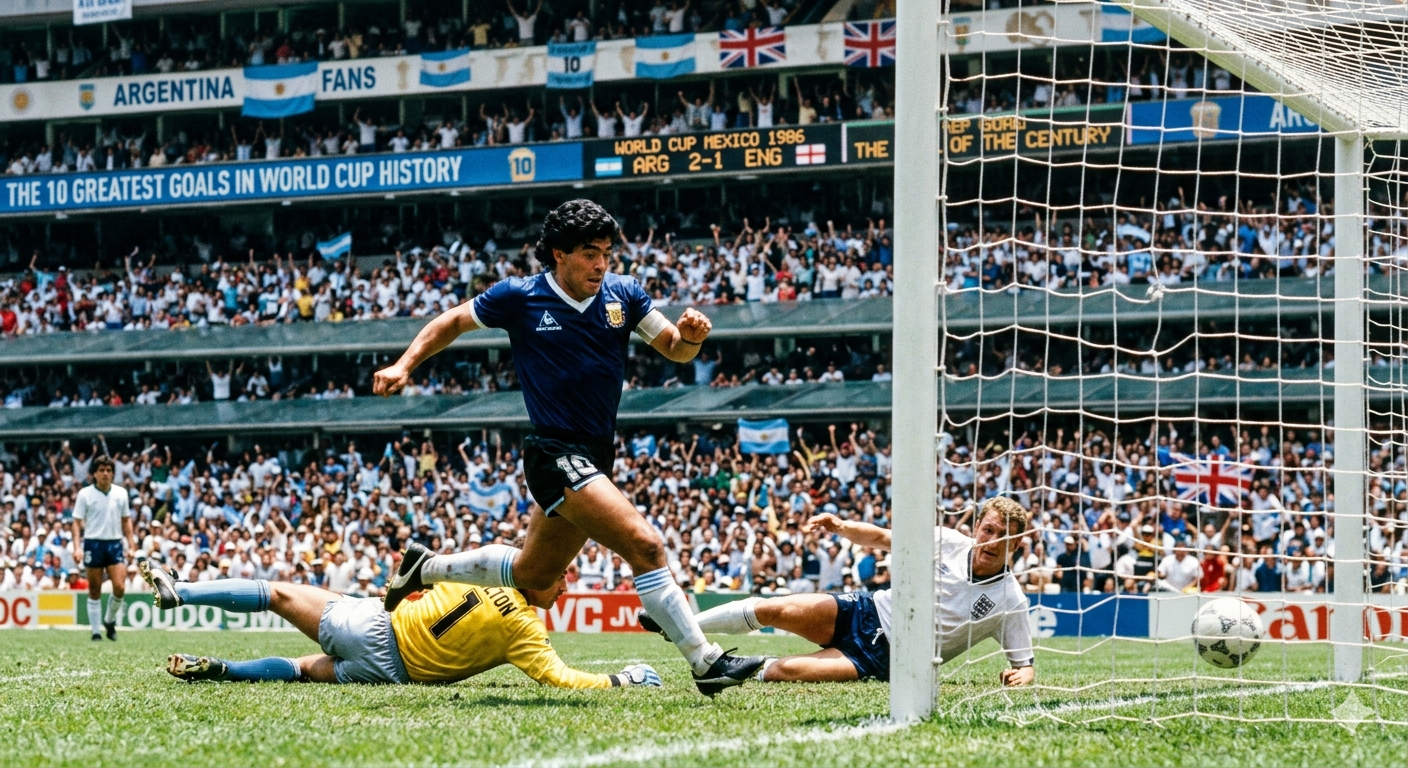
1. Diego Maradona — Argentina vs England, 1986 Quarter-Final
There is no debate. The greatest goal ever scored at a World Cup is Maradona’s second goal against England in the 1986 quarter-final — the Goal of the Century, as it was voted by FIFA fans in 2002 and has been reconfirmed in every subsequent poll.
Maradona received the ball just inside his own half, 10 yards inside the Argentina half, with his back half-turned to goal. He turned and ran. He went past Peter Reid. He went past Peter Beardsley. He went past Terry Butcher. He went past Terry Fenwick. He drew Peter Shilton from his goal — the finest English goalkeeper of his generation — and swept the ball into the net with his left foot, past Shilton’s outstretched dive, into the corner.
The run covered 60 metres. He beat six Englishmen. It lasted eleven seconds. The BBC commentator Barry Davies had no words ready and simply said: “You have to say that is magnificent.”
He scored it four minutes after the Hand of God. In the same match. In the same quarter-final.
Read the full story of Maradona’s World Cup legacy — and how it compares to Messi’s 2022 triumph — in our Maradona vs Messi: The World Cup Legacy Debate. And for the 10 greatest World Cup upsets these goals were often part of, read our complete ranking.
The detail that makes it extraordinary: He did it four minutes after cheating. As if to prove he didn’t need to.
Further Reading
For the stories behind every tournament these goals were scored in, read our complete history of the FIFA World Cup (1930–2026). For the full record of every champion, see our World Cup winners list.
For those wanting to understand the tactical evolution that produced these moments:
- “Inverting the Pyramid” by Jonathan Wilson — The definitive history of football tactics, covering every era in which these goals were scored. Available on Amazon
- “The Ball is Round” by David Goldblatt — The global history of football that puts every World Cup moment in its proper context. Available on Amazon
World Cup Tribune is the definitive English-language reference on FIFA World Cup history. Every claim in this article draws on official FIFA records, contemporaneous match reports, and verified sports journalism.