
This post contains affiliate links. If you purchase through these links, we may earn a small commission at no extra cost to you.
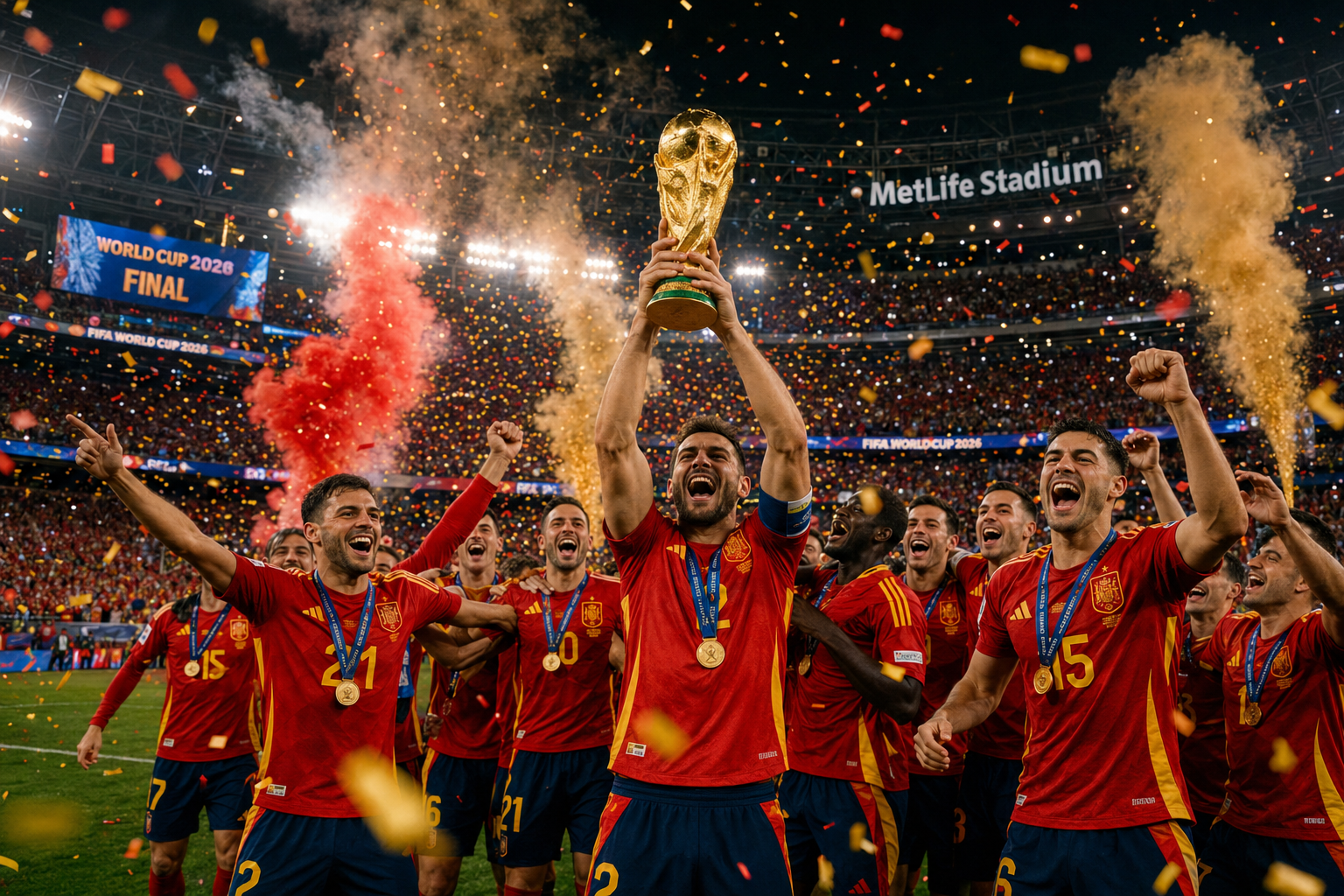
Spain are world champions for the second time. Ferran Torres, on the pitch for less than an hour as a substitute, struck in the 106th minute to give Spain a 1-0 extra-time win over Argentina in the 2026 FIFA World Cup final at MetLife Stadium on July 19, extending Luis de la Fuente’s side to a second star and closing the book on a tense, bad-tempered showdown between the reigning European and South American champions.
It is Spain’s first World Cup title since 2010, and it comes at the expense of a 10-man Argentina side that never recovered from Enzo Fernández’s late red card.
How Spain Won It
The match was goalless and cagey through 90 minutes, with Spain dominating possession but unable to find a breakthrough against a well-organized Argentina defense marshaled by Lionel Scaloni. The turning point arrived in the 90th minute, when midfielder Enzo Fernández picked up a second yellow card for a foul on Barcelona teenager Pau Cubarsí, leaving Argentina to play all of extra time a man down.
Spain made the extra man count. Torres, who had entered as a 62nd-minute substitute for Mikel Oyarzabal, latched onto a knockdown from Nico Williams — who had headed on Pedro Porro’s cross — and finished from close range in the 106th minute. It proved to be the only goal of the game.
Spain finished the match having out-shot Argentina 20-3, and remarkably, Argentina did not register a single shot in normal time of a World Cup final. Torres became only the second substitute ever to score the winning goal in a World Cup final, after Germany’s Mario Götze against Argentina in 2014 — a cruel piece of history repeating itself for the Albiceleste.
The Storylines Behind the Scoreline
Spain’s 65-year-old head coach, Luis de la Fuente, became the oldest manager ever to lead a team to a World Cup title, capping a tournament in which Spain went unbeaten from the group stage through the final.
For Argentina, the result raises fresh questions about Lionel Messi’s international future. At 39, Messi was held without a shot in the final and admitted afterward to feeling “really very tired.” He has not confirmed his retirement from international football, and has signed a further two years with Inter Miami in MLS, but he stopped short of ruling out that this was his final World Cup, telling reporters earlier in the tournament he could not promise a seventh appearance in 2030.
Awards and Records
FIFA’s individual awards for the 2026 tournament were confirmed alongside the final:
- Golden Ball (best player): Rodri (Spain)
- Golden Boot (top scorer): Kylian Mbappé (France), 10 goals — his second consecutive Golden Boot after 2022, and he also finished the tournament as the all-time leading scorer in World Cup history
- Golden Glove (best goalkeeper): Unai Simón (Spain)
- Young Player of the Tournament: Pau Cubarsí (Spain)
- FIFA Fair Play Award: Netherlands
Spain’s triumph also adds a new chapter to the all-time list of nations with the most World Cup semifinal appearances — Spain’s third semifinal (1950, 2010, 2026) now converts into a second title, matching the sort of conversion rate usually reserved for the sport’s dynasties. For the full historical picture of how Spain, Argentina, and every other nation stack up in the race for the most semifinals and titles, see our complete ranking of World Cup semifinal appearances.
What’s Next
Argentina’s golden generation, built around Messi and 2022-winning coach Lionel Scaloni, leaves the 2026 tournament as runners-up, with Messi’s international future now the biggest open question in the sport. Spain, meanwhile, add a second title to a golden run that began with the 2010 win in South Africa, built this time around a young core headlined by Golden Ball winner Rodri and Young Player award winner Cubarsí — a group that could credibly return to defend the title in 2030, when the tournament heads to Morocco, Portugal, and Spain itself.
Recommended Reading
For a deeper look at how this final fits into World Cup history, see our breakdowns of the greatest World Cup finals of all time and the all-time World Cup top scorers ranking, now led by Kylian Mbappé. Official retrospective books and posters covering the 2026 tournament are widely available on Amazon for fans looking to commemorate Spain’s second title.
Conclusion
Spain’s 1-0 extra-time win over Argentina completes a second World Cup triumph, sixteen years after the class of 2010, and does so with a symmetry few could have scripted: a super-sub scoring the winner, just as Mario Götze once did to break Argentine hearts. For Messi and Argentina, the tournament ends in heartbreak and uncertainty; for Spain, it is validation of a golden generation built to last.
Frequently Asked Questions
What was the final score of the 2026 World Cup final? Spain beat Argentina 1-0 after extra time, with Ferran Torres scoring the winning goal in the 106th minute.
Who scored the winning goal in the 2026 World Cup final? Ferran Torres, a 62nd-minute substitute, scored the only goal of the match in the 106th minute, assisted by Nico Williams off a Pedro Porro cross.
Who won the Golden Ball and Golden Boot at the 2026 World Cup? Spain’s Rodri won the Golden Ball as the tournament’s best player. France’s Kylian Mbappé won the Golden Boot with 10 goals, his second straight Golden Boot after 2022.
Is this Spain’s second World Cup title? Yes. Spain also won the 2010 FIFA World Cup in South Africa, beating the Netherlands 1-0. The 2026 title is their second overall.
Why was Argentina reduced to 10 men in the final? Midfielder Enzo Fernández received a second yellow card in the 90th minute for a foul on Pau Cubarsí and was sent off, leaving Argentina a man down for all of extra time.
Was this Lionel Messi’s last World Cup? Messi has not officially announced his retirement from international football, but at 39 he has spoken about being “really very tired” and has not confirmed he will play in the 2030 World Cup.