
This post contains affiliate links. If you purchase through these links, we may earn a small commission at no extra cost to you.
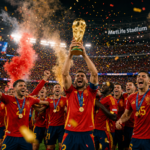
Update — July 19, 2026: Spain are 2026 World Cup champions. Ferran Torres scored an extra-time winner as Spain beat Argentina 1-0 in the final at MetLife Stadium, claiming their second title after 2010. It caps a run in which Spain also beat France 2-0 in the semifinal; Argentina beat England 2-1 in the other semifinal before losing the final. England beat France 6-4 in the third-place play-off, with Kylian Mbappé passing Lionel Messi to become the all-time leading scorer in World Cup history. Full recap: 2026 World Cup Final: Spain Stuns Argentina in Extra Time.
Introduction
Reaching a FIFA World Cup semifinal is one of the hardest things to do in team sport. Of the 211 national federations affiliated with FIFA, only 25 have ever made it that far since the tournament began in 1930. Getting knocked out in the last four still means finishing among the best sides on the planet — and for dozens of countries, it remains a summit they have never reached.
This guide ranks every nation that has played a World Cup semifinal, tournament by tournament, using official FIFA results. It covers the all-time leaders, the surprise runs that reshaped the sport’s geography, and the records most likely to fall as new football powers emerge.
A Brief History of the World Cup Semifinal
The World Cup’s format has shifted repeatedly since Uruguay hosted the first edition in 1930. That inaugural tournament used a simple pool-and-knockout format with no third-place match, so Uruguay and Argentina reached the final while the United States and Yugoslavia occupied third and fourth place without playing a bronze-medal game.
The 1950 tournament in Brazil is the trickiest to classify. Rather than a knockout semifinal, FIFA used a final round-robin group of four teams — Uruguay, Brazil, Sweden, and Spain — with the decisive Uruguay–Brazil match serving as the de facto final. FIFA itself treats those four teams as that year’s semifinalists.
From 1934 onward, a standard four-team knockout stage became the norm, and a third-place playoff was added for most editions. The field expanded from 16 teams to 24 in 1982, then to 32 in 1998, and to 48 for the 2026 tournament — but the semifinal round has stayed fixed at four teams throughout, which is exactly what makes cross-era comparisons possible.
That consistency is what makes the semifinal such a clean measuring stick across nearly a century of football. A quarterfinal exit in a 48-team format and a quarterfinal exit in a 16-team format are not really comparable achievements, since the earlier tournaments required beating far fewer opponents to get that far. Reaching the final four, however, has always meant surviving the same basic gauntlet: knock out three or more legitimate contenders in a single-elimination format with no margin for error. That is why football historians treat the all-time semifinal list, more than any quarterfinal or group-stage record, as the truest ranking of sustained national footballing power.
Complete Ranking of Teams by World Cup Semifinal Appearances
| Rank | National Team | Semifinals | Finals | Titles | First Semifinal | Last Semifinal |
|---|---|---|---|---|---|---|
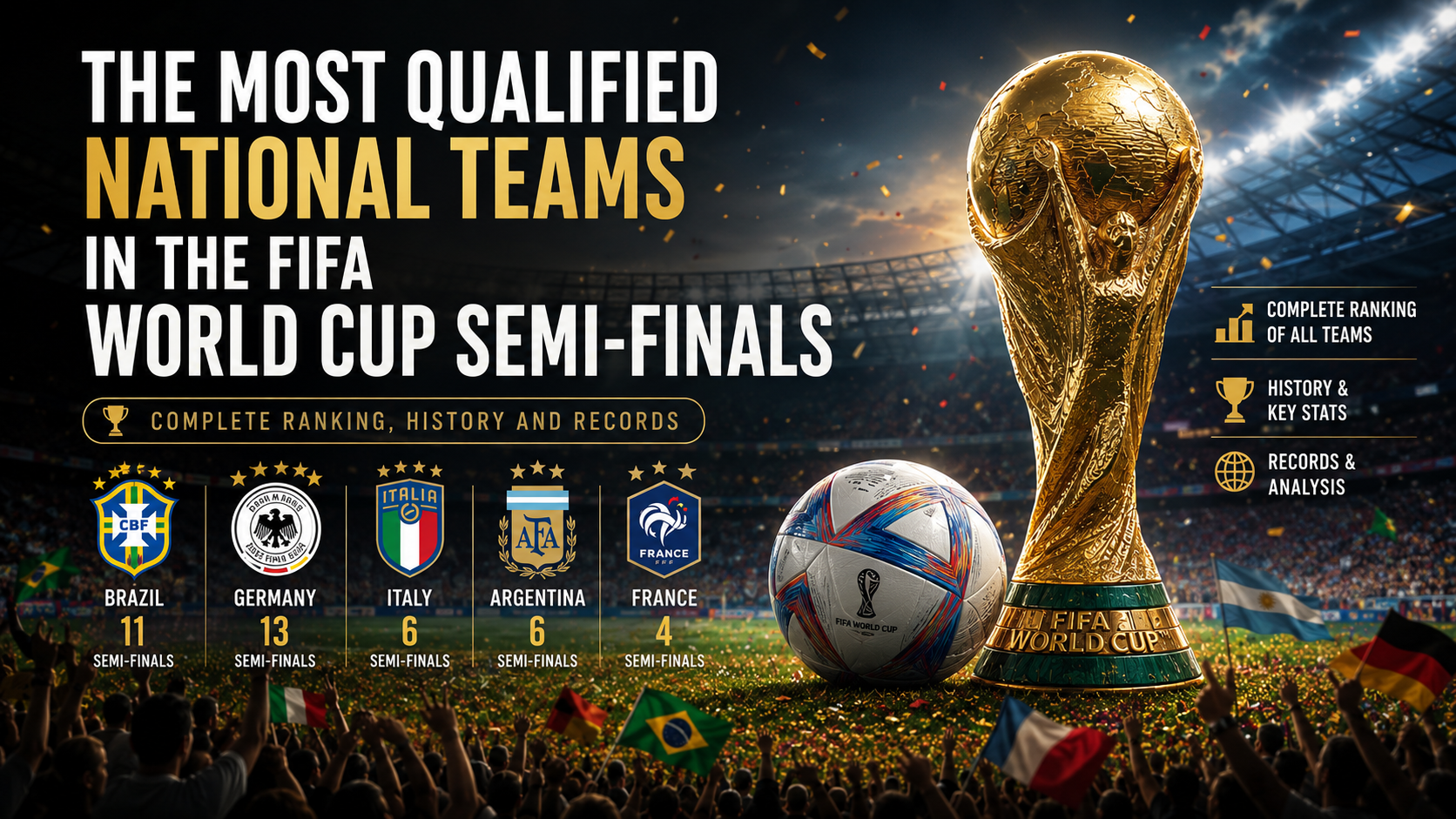
| 1 | Germany | 13 | 8 | 4 | 1934 | 2014 |
| 2 | Brazil | 11 | 7 | 5 | 1938 | 2014 |
| 3 | Italy | 8 | 6 | 4 | 1934 | 2006 |
| 4 | France | 8 | 4 | 2 | 1958 | 2026 |
| 5 | Argentina | 7 | 7 | 3 | 1930 | 2026 |
| 6 | Uruguay | 5 | 2 | 2 | 1930 | 2010 |
| 6 | Netherlands | 5 | 3 | 0 | 1974 | 2014 |
| 8 | England | 4 | 1 | 1 | 1966 | 2026 |
| 8 | Sweden | 4 | 1 | 0 | 1938 | 1994 |
| 10 | Croatia | 3 | 1 | 0 | 1998 | 2022 |
| 10 | Spain | 3 | 2 | 2 | 1950 | 2026 |
| 12 | Hungary | 2 | 2 | 0 | 1938 | 1954 |
| 12 | Czechoslovakia / Czech Republic | 2 | 2 | 0 | 1934 | 1962 |
| 12 | Poland | 2 | 0 | 0 | 1974 | 1982 |
| 12 | Austria | 2 | 0 | 0 | 1934 | 1954 |
| 12 | Portugal | 2 | 0 | 0 | 1966 | 2006 |
| 12 | Belgium | 2 | 0 | 0 | 1986 | 2018 |
| 12 | Yugoslavia / Serbia | 2 | 0 | 0 | 1930 | 1962 |
| 19 | United States | 1 | 0 | 0 | 1930 | 1930 |
| 19 | Chile | 1 | 0 | 0 | 1962 | 1962 |
| 19 | Turkey | 1 | 0 | 0 | 2002 | 2002 |
| 19 | Soviet Union / Russia | 1 | 0 | 0 | 1966 | 1966 |
| 19 | Bulgaria | 1 | 0 | 0 | 1994 | 1994 |
| 19 | South Korea | 1 | 0 | 0 | 2002 | 2002 |
| 19 | Morocco | 1 | 0 | 0 | 2022 | 2022 |
All totals above are final: Spain beat Argentina 1-0 after extra time in the 2026 final, taking their second title (2010, 2026) from two final appearances — a perfect record. Argentina finish as runners-up for the second straight tournament.
Deep Dive: The Great Semifinal Nations
Germany
Germany (including its West Germany-era record) is the undisputed leader with 13 semifinals, 8 finals, and 4 titles. Franz Beckenbauer defined two eras — as captain in 1974 and coach in 1990 — while Gerd Müller, Miroslav Klose, and Thomas Müller anchored three separate golden generations. Germany’s 7-1 demolition of host Brazil in the 2014 semifinal remains one of the most stunning results in tournament history. Read the full breakdown of Germany’s World Cup legacy here.
Brazil
The only nation to play every World Cup, Brazil has reached 11 semifinals and won a record 5 titles. Pelé, Garrincha, Zico, Ronaldo, and Ronaldinho all captained or starred in different Brazilian runs. Coach Vicente Feola’s 1958 squad won Brazil’s first title with a 17-year-old Pelé; Mário Zagallo’s 1970 side is still cited as the greatest team ever assembled.
France
France has reached 8 semifinals, including three straight from 2018 to 2026 — a streak matched only by Germany and Brazil. Michel Platini powered the 1982 and 1986 runs; Zinedine Zidane and Aimé Jacquet delivered the 1998 title on home soil; Didier Deschamps then won again as coach in 2018 with Kylian Mbappé leading a new generation — see the full France World Cup retrospective. France’s bid for a third straight final ended with a 2-0 semifinal loss to Spain in 2026, though Mbappé closed out the tournament by scoring twice in a wild 6-4 third-place loss to England — enough to pass Lionel Messi as the all-time leading scorer in World Cup history with 22 goals.
Italy
Italy’s 8 semifinals and 4 titles include the shortest imaginable modern rebuild: Vittorio Pozzo’s back-to-back titles in 1934 and 1938 remain unmatched. Paolo Rossi’s six-goal 1982 run and Marcello Lippi’s 2006 penalty-shootout triumph over France bookend a nation whose calling card has always been defensive organization built around catenaccio.
Argentina
Argentina’s semifinal count now stands at 7, spanning from the very first tournament in 1930 to 2026. Diego Maradona single-handedly carried the 1986 title, while Lionel Messi finally completed his career with the 2022 crown under coach Lionel Scaloni, beating France on penalties in one of the greatest finals ever played. Argentina reached a second straight final by beating England 2-1 in Atlanta, but Scaloni’s side fell just short of back-to-back titles, losing 1-0 in extra time to Spain at MetLife Stadium.
Uruguay
Uruguay won the first-ever World Cup in 1930 and again in 1950, upsetting host Brazil in the Maracanã in a result still called the “Maracanazo.” With 5 semifinals total, Uruguay remains the smallest nation by population ever to win multiple titles, built in recent decades around Diego Forlán, Luis Suárez, and Edinson Cavani.
England
England has reached 4 semifinals, most famously winning the 1966 title on home soil under Alf Ramsey with captain Bobby Moore and hat-trick hero Geoff Hurst. After decades of quarterfinal exits, Gareth Southgate’s side reached the semifinal in 2018, and England returned to the final four in 2026 before falling 2-1 to Argentina in Atlanta. England still went home with a medal, beating France 6-4 in a ten-goal third-place thriller powered by a Bukayo Saka hat-trick.
Netherlands
The Netherlands have reached 5 semifinals but remarkably never won the title, finishing runners-up three times (1974, 1978, 2010). Johan Cruyff’s “Total Football” side of the 1970s remains one of the most influential teams in football history despite losing back-to-back finals.
Croatia
A nation of under 4 million people, Croatia has reached 3 semifinals since its 1998 debut, finishing third that year behind Davor Šuker’s golden boot and runner-up in 2018 behind Luka Modrić’s Ballon d’Or-winning performances — one of the most remarkable per-capita records in World Cup history.
Sweden
Sweden reached 4 semifinals between 1938 and 1994, including a runner-up finish as host in 1958, when a teenage Pelé scored twice in the final against them. Sweden has not returned to the semifinal since 1994 but remains a fixture of the tournament’s early decades.
Spain
Spain’s 3 semifinals bracket the tournament’s history, from fourth place in 1950 to their 2010 title behind Andrés Iniesta’s extra-time winner and Vicente del Bosque’s tiki-taka system, and now a second title in 2026: after beating France 2-0 in the semifinal, Spain won the final 1-0 in extra time against Argentina on a Ferran Torres goal, completing an undefeated tournament under coach Luis de la Fuente.
Portugal
Portugal’s 2 semifinals came 40 years apart. Eusébio’s 1966 side finished third under coach Otto Glória, with Eusébio himself claiming the tournament’s Golden Boot. Four decades later, Luiz Felipe Scolari guided a “golden generation” built around Deco, Luís Figo, and a young Cristiano Ronaldo to fourth place in 2006, narrowly losing the third-place match to Germany.
Morocco
Morocco’s run to the 2022 semifinal was the first by any African nation in World Cup history, eliminating Spain and Portugal along the way before falling to France. Coach Walid Regragui and a squad built on European-born diaspora talent turned Morocco’s Atlas Lions into a symbol for African and Arab football.
Belgium
Belgium’s “golden generation” of Kevin De Bruyne, Eden Hazard, and Romelu Lukaku delivered a third-place finish in 2018 under coach Roberto Martínez, matching an earlier fourth-place run in 1986 led by Enzo Scifo — Belgium’s only two semifinals to date.
Czechoslovakia / Czech Republic
Czechoslovakia reached the final twice, in 1934 and 1962, without ever winning, led respectively by Oldřich Nejedlý’s goalscoring and a talented 1960s generation built around Josef Masopust. No Czech or Slovak side has returned to the semifinal since the country split in 1993.
The Longest Semifinal Streaks
Only three nations have ever reached three consecutive World Cup semifinals:
- Germany — twice, from 1982 to 1990 and again from 2006 to 2014
- Brazil — from 1994 to 2002, a run that included the 2002 title
- France — from 2018 to 2026, the most recent nation to join this list
No country has ever managed four straight semifinal appearances, which makes this trio’s achievement the benchmark for sustained excellence at the highest level of the sport.
The Great Surprises of World Cup History
Not every semifinal run came from an established power. Several nations shocked the football world by reaching the final four with squads that were underdogs on paper:
- Croatia (1998, 2018, 2022) — a country of fewer than 4 million people producing three semifinal runs within 25 years of independence
- Morocco (2022) — the first African nation ever to reach a World Cup semifinal, beating Spain and Portugal en route
- South Korea (2002) — the first Asian nation to reach a semifinal, doing so as co-host under coach Guus Hiddink
- Turkey (2002) — reaching the semifinal in their first World Cup appearance in 48 years
- Bulgaria (1994) — powered by Hristo Stoichkov’s Golden Boot-winning tournament
- Belgium (1986, 2018) — two generations, 32 years apart, both defying expectations
Semifinal Appearances by Continent
| Continent / Confederation | Semifinal Appearances |
|---|---|
| Europe (UEFA) | 65 |
| South America (CONMEBOL) | 24 |
| Africa (CAF) | 1 |
| Asia (AFC) | 1 |
| North & Central America (CONCACAF) | 1 |
| Oceania (OFC) | 0 |
Europe and South America have combined for 90 of the 92 semifinal slots filled since 1930 — every World Cup final has also been contested exclusively between UEFA and CONMEBOL nations. Only three teams from outside those two confederations have ever broken through to the semifinal stage: the United States in 1930, South Korea in 2002, and Morocco in 2022.
Historical Records
- Most semifinal appearances: Germany, 13
- Most semifinal victories (reaching the final): Germany, 8 finals
- Longest streak of consecutive semifinals: 3, shared by Germany, Brazil, and France
- Best title conversion rate among repeat semifinalists: Spain, with 2 titles from 3 semifinals (2010, 2026) — and a perfect record in finals reached (2 from 2). Italy and Argentina are next, each converting roughly half of their semifinal appearances into titles
- Most semifinal appearances without a title: Netherlands, 5
- First African nation in a semifinal: Morocco, 2022
- First Asian nation in a semifinal: South Korea, 2002
- First nation outside Europe or South America in a semifinal: United States, 1930
- Most goals in a match at the final-four stage: 10, England 6-4 France (2026 third-place play-off) — the first World Cup match with double-digit goals since 1982
- All-time leading World Cup scorer: Kylian Mbappé (France), 22 goals, passing Lionel Messi during the 2026 third-place play-off — see the complete all-time scorers ranking
Current Trends and Rising Powers
The last three tournaments have shown the semifinal club widening slightly beyond its traditional membership. Morocco’s 2022 run proved that African federations can now match Europe’s physical and tactical standards, while Croatia’s sustained success shows that smaller European federations with strong youth academies can compete with far larger nations.
Belgium’s golden generation demonstrated how a country of 11 million people can build a squad capable of matching Brazil or France on a given day, and Japan and the United States — both quarterfinal-round threats in recent cycles — are frequently cited as the next candidates to break into the semifinal club, aided by the expanded 48-team format that gives more confederations additional direct qualification slots.
The 48-team era is also the first genuine test of whether CONCACAF and CAF can turn their added qualification spots into deeper knockout runs rather than just more first-round appearances. Co-hosting the 2026 tournament has given the United States, Mexico, and Canada extra preparation time and home-crowd advantage through the group stage and round of 16, but reaching the final four still requires beating traditional European or South American opposition in a straight knockout match — the same barrier that has held outsiders back for nearly a century. Whether that barrier finally falls again in 2026, or waits for a future edition, will shape how this ranking looks a decade from now.
Recommended Reading and Memorabilia
For readers who want to go deeper into this history, a few titles stand out. Brazil 1970: How the Greatest Team of All Time Won the World Cup by Sam Kunti offers a detailed account of Brazil’s most celebrated squad. Das Reboot by Raphael Honigstein explains how Germany rebuilt its national team into the machine that produced back-to-back semifinal streaks. For fans who want a physical piece of this history, official World Cup retrospective posters and Panini sticker albums covering past tournaments are widely available on Amazon and make excellent gifts for collectors.
Conclusion
Thirteen nations have played in a World Cup final; twelve more have reached the semifinal without ever getting that far. Germany and Brazil remain in a class of their own, but the gap is narrowing — France’s run to a third straight semifinal in 2026, and Morocco’s historic 2022 breakthrough, both suggest the list of nations capable of reaching the final four is slowly growing. The next country to join this table, whether from Africa, Asia, or North America, may not be far away.
See also: 2026 World Cup Final: Spain Stuns Argentina in Extra Time | Germany at the World Cup: Four Titles and a Legacy of Excellence | All-Time World Cup Top Scorers: The Complete Ranking
Frequently Asked Questions
Which team has played in the most World Cup semifinals? Germany has reached the most World Cup semifinals with 13, including its record as West Germany from 1954 to 1990. Brazil is second with 11.
How many times has Brazil reached the World Cup semifinal? Brazil has reached the semifinal 11 times, going on to win the title in 5 of those appearances — a conversion rate no other nation has matched.
Does France have more semifinals than Italy? Italy and France are now tied at 8 semifinal appearances each, though Italy holds more titles (4 to France’s 2) and more final appearances (6 to France’s 4).
Which was the first African team to reach a World Cup semifinal? Morocco became the first African nation to reach a World Cup semifinal at the 2022 tournament in Qatar, eliminating Spain and Portugal before losing to France.
Which country has won the most World Cups? Brazil has won the most World Cup titles with 5, followed by Germany and Italy with 4 each, and Argentina with 3.
Which team has the best semifinal-to-title conversion rate? Spain has the best conversion rate among repeat semifinalists, turning 2 of its 3 semifinal appearances (2010, 2026) into titles, with a perfect 2-for-2 record in finals reached. Italy and Argentina are next, each converting roughly half their semifinal trips into titles.
How many different nations have reached a World Cup semifinal? Twenty-five national teams have reached at least one World Cup semifinal since 1930, including the successor records of Czechoslovakia, Yugoslavia, and the Soviet Union.
Who won the 2026 World Cup? Spain won the 2026 FIFA World Cup, beating Argentina 1-0 after extra time in the final at MetLife Stadium on July 19. Ferran Torres scored the winning goal, and it is Spain’s second title after 2010.
What were the 2026 World Cup semifinal and third-place results? Spain beat France 2-0 in Dallas, and Argentina beat England 2-1 in Atlanta. England then beat France 6-4 in the third-place play-off, with Kylian Mbappé passing Lionel Messi to become the all-time leading World Cup scorer.