
This post contains affiliate links. If you purchase through these links, we may earn a small commission at no extra cost to you.
The 1970 FIFA World Cup was not simply a football tournament. It was a work of art played in cleats on sun-baked pitches at altitude. Held in Mexico from May 31 to June 21, 1970, it gave the world Pelé at his peak, the most iconic save in football history, and a Brazil team so breathtaking that fans still argue — more than fifty years later — whether any international side has ever matched them.
This is the complete guide to the 1970 World Cup: the host nation, the squads, the unforgettable moments, and why this tournament remains the gold standard of the beautiful game.
The 1970 World Cup at a Glance
| Fact | Details |
|---|---|
| Host Country | Mexico |
| Dates | May 31 – June 21, 1970 |
| Teams | 16 |
| Matches Played | 32 |
| Goals Scored | 95 (avg. 2.97 per game) |
| Winner | Brazil |
| Runner-up | Italy |
| Top Scorer | Gerd Müller (West Germany) — 10 goals |
| Tournament MVP | Pelé (Brazil) |
| Attendance | 1,673,975 total |
Why Mexico? The First Repeat Host
Mexico became the first country to host the FIFA World Cup twice — having previously staged the tournament before Colombia withdrew due to financial concerns.
The choice of Mexico brought unique challenges. Six of the nine venues sat above 2,000 meters in altitude — including the Estadio Azteca in Mexico City at 2,216 meters. European teams in particular struggled to adapt to the thin air and searing midday heat, a scheduling decision made at FIFA’s request to suit European television broadcasts.
Despite the controversy, the altitude seemed to energize rather than diminish the football. Goals came freely, defending was an afterthought, and the tournament produced some of the most exhilarating matches in World Cup history.
Brazil’s Squad: The Most Talented Team in History?
Manager Mário Zagallo assembled what many historians consider the greatest international squad ever gathered. The starting lineup read like a hall of fame:
- Pelé — Already a two-time World Cup winner at 29, he arrived in Mexico desperate to prove he could still dominate on the world stage after an injury-plagued 1966.
- Jairzinho — The “Hurricane” scored in every single game of the tournament — the only player ever to achieve this feat in a World Cup.
- Rivelino — A thunderous left foot and extraordinary vision made him one of the most complete midfielders of his generation.
- Tostão — A silky forward who combined with Pelé in a devastating partnership that confused every defense they faced.
- Carlos Alberto Torres — The captain was the definition of an attacking full-back, whose presence in the final would prove decisive.
- Gérson — The engine room of the team, controlling tempo from deep and providing the assist for one of the most celebrated goals in football history.
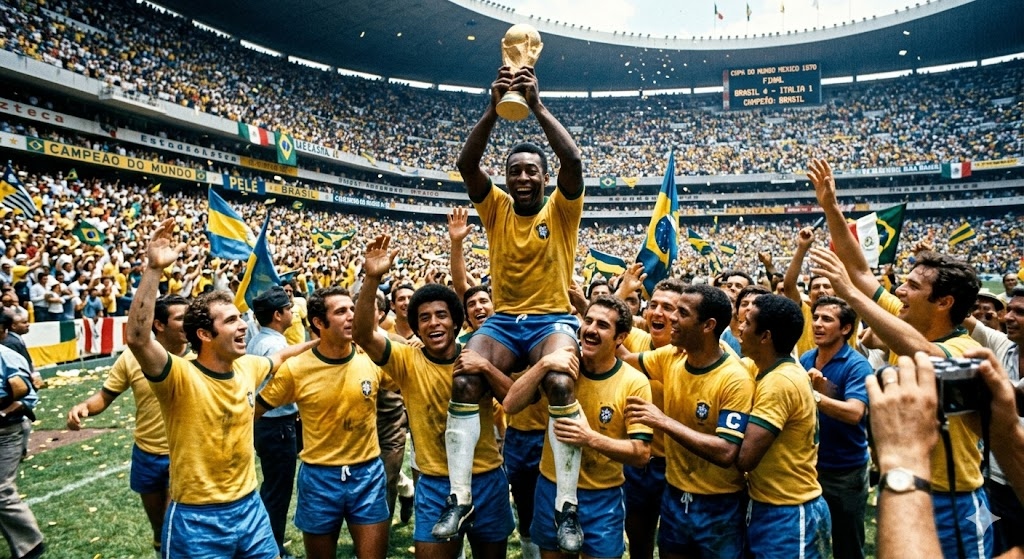
Brazil wore their famous yellow shirts and blue shorts, becoming the first team to win three World Cups — earning the right to keep the Jules Rimet Trophy permanently.
Brazil’s 1970 World Cup Results
| Stage | Opponent | Score |
|---|---|---|
| Group Stage | Czechoslovakia | 4–1 |
| Group Stage | England | 1–0 |
| Group Stage | Romania | 3–2 |
| Quarter-final | Peru | 4–2 |
| Semi-final | Uruguay | 3–1 |
| Final | Italy | 4–1 |
The Iconic Moments That Defined Mexico 1970
The Save of the Century — England vs. Brazil
Before Brazil could lift the trophy, they had to navigate a group stage clash with defending champions England that produced the single most celebrated moment of the entire tournament — and it wasn’t a goal.
In the 10th minute, England captain Bobby Moore delivered a precise cross to Jairzinho on the right. His whipped cross found Pelé unmarked at the far post. Pelé headed the ball with conviction, already shouting “Gol!” — and Gordon Banks, England’s goalkeeper, somehow flung himself to his right, scooped the ball from below knee height, and turned it over the bar.
Pelé later called it “the greatest save I have ever seen.” Banks himself couldn’t explain how he did it. The image of his outstretched right arm, his body parallel to the turf, became one of the defining photographs of 20th century sport. Brazil won the game 1–0.
The Game of the Century — West Germany vs. Italy
If the Save of the Century defined the group stage, the semi-final between West Germany and Italy defined drama itself. Italy led 1–0 going into the final minutes. Then Karl-Heinz Schnellinger equalized in the 90th minute, sending the match to extra time.
What followed was extraordinary — five goals in 30 minutes. Franz Beckenbauer played the entire second half of extra time with a dislocated shoulder, his arm strapped to his side, refusing to leave the pitch. Italy’s Gianni Rivera scored the winning goal in the 111th minute to send the Azzurri through 4–3. FIFA later officially designated this match “The Game of the Century”, and a plaque at the Estadio Azteca still commemorates it today.
The 1970 World Cup Final — Brazil 4–1 Italy
The final, played on June 21 before 107,412 fans at the Estadio Azteca, was the coronation Brazil’s football deserved. Pelé headed Brazil into the lead in the 18th minute — his trademark leap, his eyes closed, the ball timed to perfection. Italy equalized through Roberto Boninsegna, and the first half ended level.
The second half belonged entirely to Brazil. Gérson’s long-range drive, Jairzinho’s close-range finish (completing his extraordinary run of scoring in every game), and then — in the 86th minute — one of the greatest team goals in football history. Clodoaldo began a run from deep in his own half, dribbling past four Italian players. The ball moved through Rivelino, Tostão, Jairzinho, and finally to Carlos Alberto Torres — the captain — steaming in from the right flank to hammer a right-footed shot into the corner of the net.
The goal was so perfectly constructed, so total in its expression of Brazilian football philosophy — jogo bonito, the beautiful game — that it has never left the public consciousness.
Gerd Müller: The Unlikely Top Scorer
While Brazil captured all the romance, West Germany’s Gerd Müller was the tournament’s most lethal finisher. The stocky striker from Bayern Munich scored 10 goals in 6 games — a record that stood until Ronaldo broke it at the 2002 World Cup. His tally included hat-tricks against Bulgaria and Peru, and his clinical instinct in the penalty area earned him the nickname “Der Bomber.” Müller also won the Golden Boot and was named in the All-Star squad alongside Pelé, Beckenbauer, and Bobby Moore.
The Jules Rimet Trophy — Retired Forever
Brazil’s third World Cup title had a historic consequence: FIFA’s rules stipulated that the first nation to win three tournaments would keep the Jules Rimet Trophy permanently. On June 21, 1970, Brazilian Football Confederation president João Havelange received the trophy from FIFA president Sir Stanley Rous.
Brazil took it home to Rio de Janeiro, where it was displayed at the CBF headquarters — until December 1983, when thieves broke in and stole it. It has never been recovered. The golden trophy that Pelé lifted in Mexico City in 1970 was gone forever. What remains is the memory, the footage, and the legacy of the team that won it.
Recommended Books and Collectibles for 1970 World Cup Fans
The 1970 World Cup has inspired some of the finest football literature ever published. If you want to relive this extraordinary tournament in depth, these are the best books and collectibles available:
- “How Soccer Explains the World” by Franklin Foer — This acclaimed analysis of global football culture provides essential context for why Brazil’s 1970 victory meant so much beyond the sport. Available on Amazon.
- “The Beautiful Game: My World Soccer Story” by Pelé — Pelé’s own account includes an extraordinary chapter on the 1970 World Cup, told with remarkable personal detail. Essential reading for any fan of the tournament. Available on Amazon.
- “Brilliant Orange” by David Winner — Explains how Brazil’s total football inspired an entire generation of European coaches who watched Mexico 1970 in awe. Available on Amazon.
- Panini World Cup Sticker Albums (Vintage Reprints) — Panini’s official reprint collections of classic World Cup sticker albums, including 1970, are beautiful historical documents. Available on Amazon.
- Brazil Retro 1970 Jersey — The classic yellow and blue shirt worn by Pelé, Jairzinho and Carlos Alberto. Available on Amazon.
Frequently Asked Questions About the 1970 FIFA World Cup
Who won the 1970 FIFA World Cup?
Brazil won the 1970 FIFA World Cup, defeating Italy 4–1 in the final at the Estadio Azteca in Mexico City on June 21, 1970. It was Brazil’s third World Cup title — and their most celebrated.
Who scored in every game at the 1970 World Cup?
Brazil’s winger Jairzinho scored in all six of Brazil’s games at the 1970 World Cup, including the final against Italy. He remains the only player in World Cup history to score in every game of a tournament.
What was the Game of the Century in 1970?
The Game of the Century refers to the 1970 World Cup semi-final between West Germany and Italy, which Italy won 4–3 after extra time. The match featured five goals in extra time and is still considered one of the greatest football matches ever played.
Who was top scorer at the 1970 World Cup?
West Germany’s Gerd Müller was the top scorer at the 1970 World Cup with 10 goals in 6 games — a record that stood for 32 years until Ronaldo at the 2002 World Cup.
What happened to the Jules Rimet Trophy after 1970?
Brazil permanently kept the Jules Rimet Trophy after winning their third World Cup in 1970. It was displayed at the CBF headquarters in Rio de Janeiro until 1983, when it was stolen by thieves and never recovered.
How many teams played in the 1970 World Cup?
16 teams competed at the 1970 FIFA World Cup in Mexico, playing 32 matches over 22 days.
The Legacy of Mexico 1970
More than five decades have passed since Pelé lifted the Jules Rimet Trophy on that June evening in Mexico City. The 1970 World Cup remains the most frequently cited answer to the question: “When was football at its most beautiful?”
The tournament inspired generations of coaches across South America and Europe, and produced moments — the Save of the Century, the Game of the Century, Carlos Alberto’s final goal — that have never faded from collective memory. Every four years, when a new generation steps onto a World Cup pitch, they do so in the long shadow of what Brazil achieved in Mexico. That is the true legacy of 1970.
See also:
The 1966 FIFA World Cup: England’s Finest Hour | Pelé: World Cup Record and Legacy | The Greatest World Cup Finals of All Time | Best World Cup Books of All Time