
Affiliate disclosure: World Cup Tribune participates in the Amazon Associates Programme and other affiliate programmes. We may earn a commission on qualifying purchases at no extra cost to you.
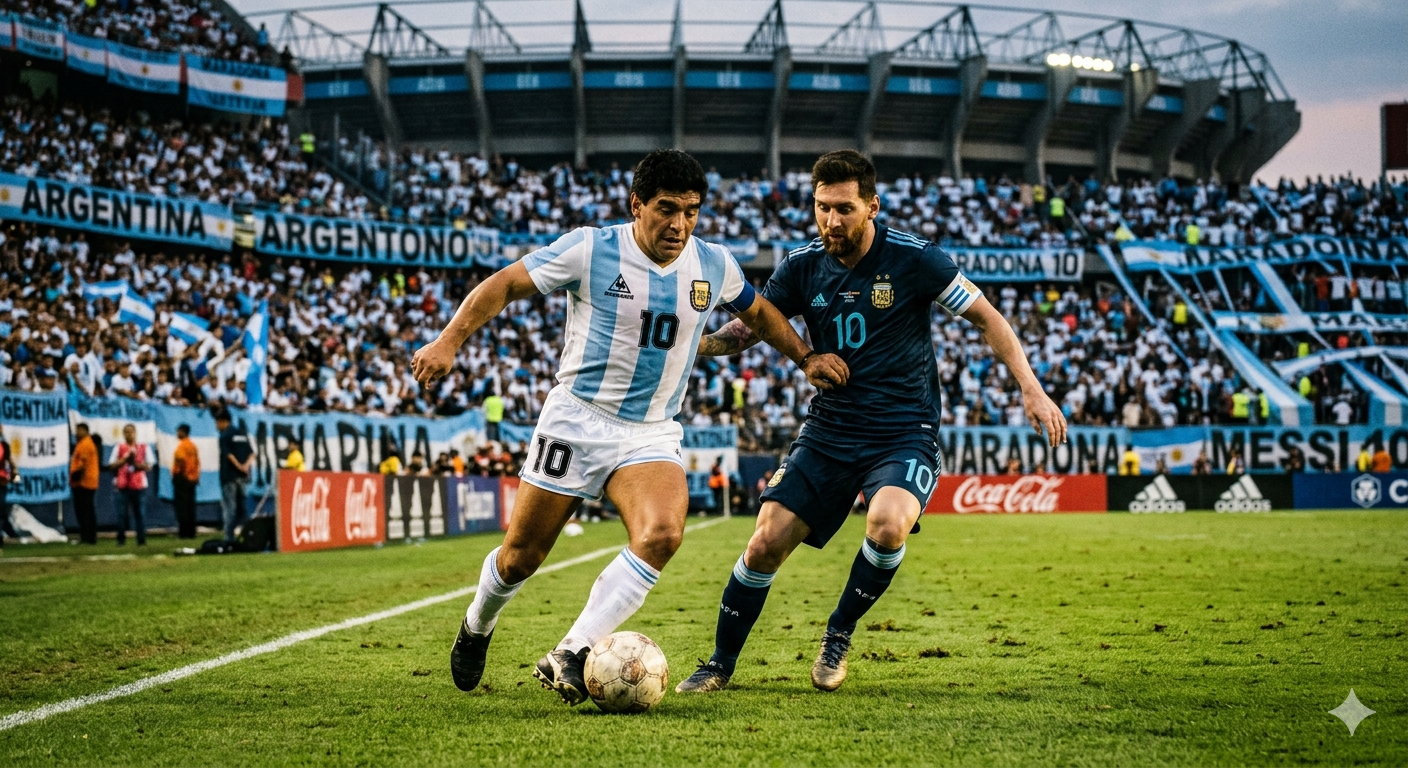
Maradona vs Messi: The World Cup Legacy Debate
In the summer of 1986, a compact, dark-haired Argentine drove through the heart of the England midfield and scored the greatest goal in World Cup history. Sixteen years later, a skinny teenager from Rosario was scouted by Barcelona, where he would grow into the most statistically dominant footballer the world had ever seen. Eventually he too would win the World Cup — in the most dramatic final ever played.
Diego Armando Maradona. Lionel Andrés Messi. Two Argentines, two World Cup winners, one argument that will run for as long as football is played.
This is not a piece about who was the better player in absolute terms — that debate spans their entire careers, from club football to individual brilliance. This is specifically about the Maradona vs Messi World Cup question: whose tournament legacy is greater, and what does each man’s record at football’s greatest stage actually tell us?
The Numbers: What Each Man Actually Did
Before the arguments begin, the facts.
Diego Maradona at the World Cup:
| Year | Host | Stage Reached | Goals | Assists | Result |
|---|---|---|---|---|---|
| 1982 | Spain | Group Stage | 2 | 0 | Group exit |
| 1986 | Mexico | Winner | 5 | 5 | Champion |
| 1990 | Italy | Runner-Up | 0 | 3 | Final (lost) |
| 1994 | USA | Round of 16 | 1 | 1 | Expelled (doping) |
Total: 8 goals, 9 assists in 21 matches. One title. One final. One group exit. One expulsion.
Lionel Messi at the World Cup:
| Year | Host | Stage Reached | Goals | Assists | Result |
|---|---|---|---|---|---|
| 2006 | Germany | Quarter-Final | 1 | 1 | QF exit |
| 2010 | South Africa | Quarter-Final | 0 | 1 | QF exit |
| 2014 | Brazil | Runner-Up | 4 | 1 | Final (lost) |
| 2018 | Russia | Round of 16 | 1 | 1 | R16 exit |
| 2022 | Qatar | Winner | 7 | 3 | Champion |
Total: 13 goals, 7 assists in 26 matches. One title. One final lost. Two quarter-final exits. One Round of 16 exit.
The raw numbers favour Messi in volume. But numbers, as always in football, are only part of the story.
Maradona 1986: The Greatest Individual Tournament in World Cup History
To understand why the Maradona vs Messi debate remains genuinely contested, you have to understand what Maradona did in Mexico in 1986. It was not merely winning the World Cup. It was how he won it.
Argentina in 1986 were a very good side but not a great one — certainly not the dominant outfit their victory might suggest. They had Valdano, Burruchaga, Ruggeri. What they had above all was Maradona, who played with a ferocity and invention that has never been matched in a single tournament.
He scored five goals and created five more. He produced the Hand of God and the Goal of the Century in the same match against England — within four minutes of each other. He carried a nation’s World Cup on his shoulders in the most literal sense, and Argentina lifted the trophy because of him rather than despite their limitations.
His five assists in 1986 are particularly telling. Maradona was not just a scorer; he was the architect of everything Argentina built. The decisive goal in the final — Burruchaga’s 84th-minute winner against West Germany — came from a Maradona through-ball of devastating precision, played while three defenders tracked him.
No player in World Cup history has been as dominant in a single tournament. Not Pelé in 1970. Not Ronaldo in 2002. Not Messi in 2022. Maradona in 1986 is the ceiling.
Messi 2022: The Long Road to Glory
Lionel Messi’s relationship with the World Cup was, for most of his career, football’s greatest unfulfilled promise. Four tournaments. Zero titles. A nation that loved him but could never quite forgive him for not being Maradona.
The 2006, 2010, and 2018 campaigns ranged from disappointing to catastrophic. In 2010, Messi played 450 minutes and scored no goals. In 2018, he was peripheral as Argentina crashed out to France in the last 16 — a match in which a 19-year-old Kylian Mbappé outshone him completely.
By 2022, Messi was 35. This was his last World Cup, and everyone knew it. Argentina entered Qatar having not lost in 36 matches. The weight of expectation was unlike anything any footballer had ever carried.
What followed was one of the great individual tournament performances in World Cup history — matched, perhaps, only by Maradona in 1986. Messi scored seven goals. He provided three assists. He guided Argentina through the most dramatic final ever played, a 3–3 extra-time draw against France that required penalties, after Argentina had led 2–0 with ten minutes to play.
Messi’s goal in the final — a composed finish after a penalty-box move — was the 793rd goal of his career. He won the Golden Boot and the Golden Ball. He became, at last, a world champion.
The image of Messi sitting alone in the Lusail dressing room afterwards, golden ball in hand, wearing the trophy-winning strip, is one of the defining photographs in football history.
The Crucial Question: Context
The most important factor in the Maradona vs Messi World Cup debate is context — and here is where honest analysis becomes uncomfortable for partisans on both sides.
Maradona’s case: He won the World Cup essentially alone. Argentina’s squad in 1986 was good but not exceptional. In 1990, with an even weaker team, he dragged them to the final again — this time against a superior West Germany side. Two finals from two tournaments is an astonishing record, particularly when the supporting cast is fairly assessed.
Messi’s case: Argentina’s 2022 squad — Di María, de Paul, Álvarez — was genuinely formidable around him. Messi’s performance was decisive, but he was operating within a well-organised tactical system under Lionel Scaloni that 1986 Maradona never had. The 2022 Argentina team was more balanced and less dependent on a single genius than the 1986 edition.
The counter-argument: Messi won five World Cup matches at the 2022 tournament, each time when Argentina had something significant to lose. He scored in the semi-final against Croatia and twice in the final against France. At 35, in his last tournament, with the weight of a nation’s expectation on him, he delivered. That is not nothing.
1990: Maradona’s Overlooked Masterclass
Few remember how extraordinary Maradona was in 1990, because Italy is remembered as the tournament of catenaccio and penalty shootouts rather than individual brilliance. But Argentina reached the final with a squad that had no right to be there.
Maradona scored no goals in the 1990 knockout rounds. He assisted three. But his influence on every match Argentina played was the decisive factor in a run that included wins over Brazil, Yugoslavia, and Italy — the host nation, on Italian soil, on penalties in the semi-final — before losing the final 1–0 to West Germany via a disputed penalty.
The 1990 campaign is Maradona’s forgotten masterpiece: doing more with less than almost any other player in World Cup history.
What the Debate Actually Reveals
The reason the Maradona vs Messi debate endures is that both men are, in different ways, beyond ordinary comparison.
Maradona’s 1986 tournament is the single greatest individual performance in the 96-year history of the World Cup. Nothing before or since has matched it for dominance, drama, and decisive brilliance. If the debate is about peak impact at a single tournament, Maradona wins and the margin is wide.
Messi’s World Cup legacy is the richer body of work. Five tournaments. 26 matches. 13 goals. A Golden Ball in 2014 — when Argentina lost the final — and another in 2022 when they won it. A career of near-misses resolved, finally and definitively, in the most dramatic tournament finale in football history.
If the debate is about the complete World Cup career — the accumulation of performances across tournaments and decades — Messi’s record is objectively superior.
The truest answer is that both men are, by any rational measure, the two greatest players in Argentine football history, and each defines something essential about the World Cup at its best: Maradona the lightning bolt, Messi the thunderstorm.
Argentina’s 2026 Prospects
The debate has one more chapter still to be written. Messi has confirmed he intends to play at the 2026 World Cup — hosted across the United States, Canada, and Mexico, with a final scheduled for MetLife Stadium in New York. He will be 38. Argentina are the defending champions. If he plays and wins, no comparison to Maradona will survive scrutiny.
For the complete history of every World Cup winner and the tournaments both men inhabited, read our definitive list. And for the upsets that shaped Argentina’s World Cup story — including that Saudi Arabia defeat that Messi’s 2022 team overcame — see our guide to the greatest World Cup upsets of all time.
Essential Reading on Both Men
The literature on Maradona and Messi is extensive. These are the titles that offer the deepest insight into their World Cup legacies:
- “Maradona: The Hand of God” by Jimmy Burns — The definitive English-language biography, covering his 1986 triumph and the full arc of his turbulent genius. Available on Amazon
- “Messi” by Guillem Balagué — The authorised biography, tracing his path from Rosario to five World Cups and the 2022 final. Available on Amazon
- “The Ball is Round” by David Goldblatt — Essential context for every World Cup era both men played in. Available on Amazon
For those who want to wear the argument rather than read it: Argentina’s 1986 retro kit (Maradona’s tournament) and the 2022 home shirt (Messi’s title) are both available through Fanatics and Amazon. The kits alone make the case for why this is football’s most enduring debate — two different strips, two different eras, one country, one argument.
World Cup Tribune is the definitive English-language reference on FIFA World Cup history. Every claim in this article draws on official FIFA records, contemporaneous match reports, and verified sports journalism.